
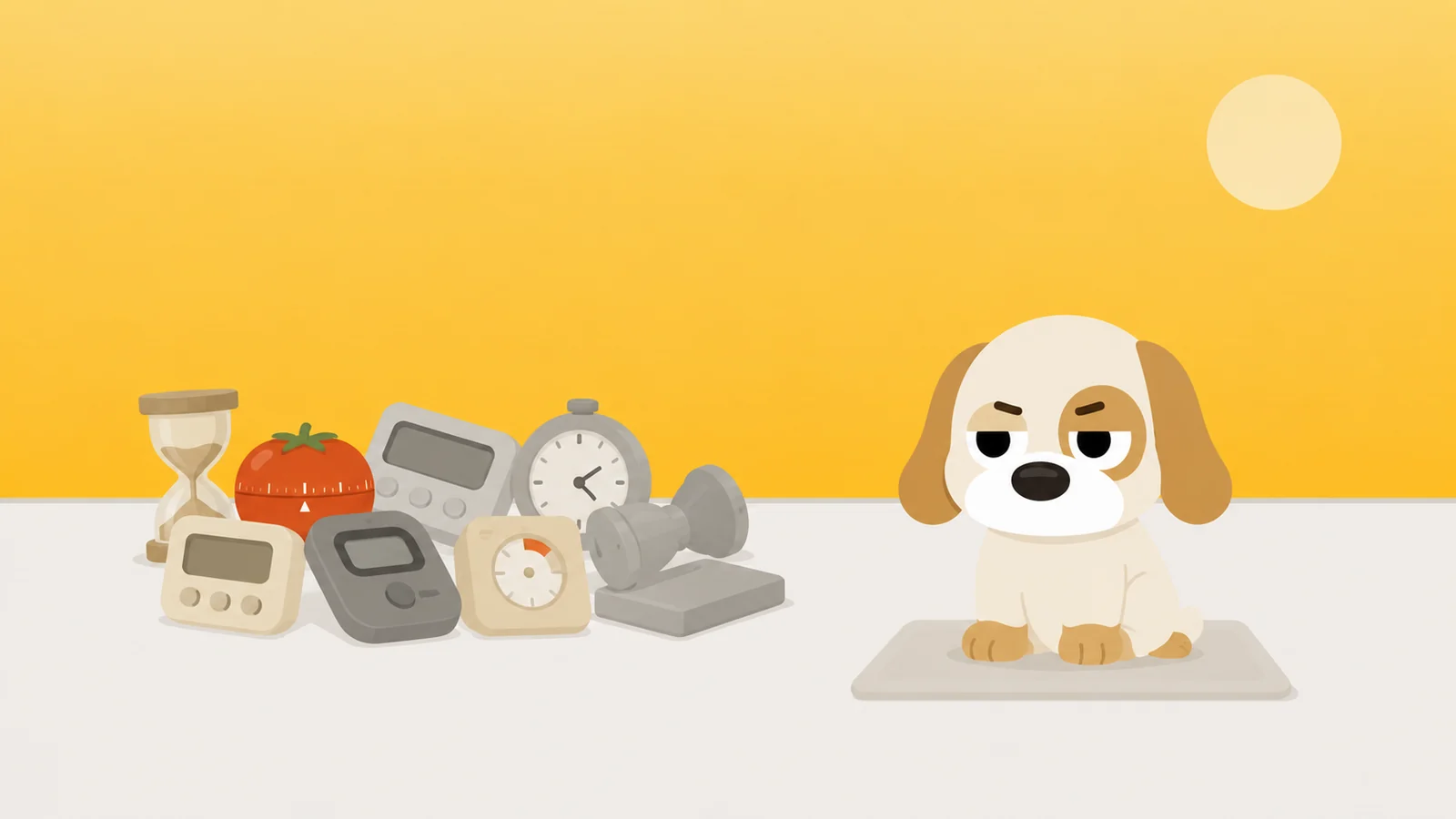
You have paid for four focus apps and the document has been open since ten.
We are the tenth one. That is the position this is written from and there is no graceful way around it, so here is the rest of the awkwardness up front: what follows is an argument that our thing is built differently, you have read nine of those, and the people who wrote the other nine were not lying either.
So we will do it backwards. Before anything at all about what we make, the part that stays true whether or not you ever hear from us again: why the ones you already bought stopped, and roughly when.
Do this before you read the rest of the page
Open Settings, tap your name at the very top, tap Subscriptions, and scroll to the bottom. There is a section down there called Expired.
Count the ones in it that were bought to fix this exact problem. The focus timer. The blocker. The habit tracker with the streak. The one somebody swore by in March.
Then, for any of them still installed, do the second half: Settings › Screen Time › See All App & Website Activity, switch the control at the top to Week, and find it in the app list. Read the minutes next to it.
Under a minute a week does not mean it is not helping. It means it died, on a date you did not notice, and has been sitting on a home screen page ever since as a small daily reminder that you tried.
That is the entire diagnostic, and the number you just produced is the only number in this article worth anything, because it is yours. We are not going to quote you a survey about how many people abandon productivity apps. There is not an honest one to quote, and forty seconds of your own Settings beats it anyway.
Nine attempts is not a character flaw. Nine attempts is somebody who kept trying. I notice that sort of thing.
The dates in that list are lying to you
Look at when each expired subscription ran out. Every one of those dates is later than the truth.
A subscription expires when the money stops. You stopped long before the money did. If you paid yearly, the app is carrying a date roughly eleven months after the last evening you actually opened it. If you paid monthly it is still about three weeks generous.
The list records when you cancelled. It has nothing at all to say about when it failed.
That gap changes the story you tell yourself about it. By the dates, the story is: I tried a thing for a year and it did not work for me. The real one is: I tried a thing for nine days, then paid for it for a year, and did not think about it again until a web page asked me to go and look.
Nothing decayed in week two, because nothing was there yet to decay
This next part is uncomfortable and it applies to us as much as to anybody in that Expired list.
Think about what the first evening actually consisted of. You read about the app. You installed it. You went through your home screen picking which things to guard, set the times, had a genuine internal argument about whether Slack counts, watched the tour, and were still in a settings screen the better part of an hour later.
That hour was an hour spent thinking hard about this problem instead of scrolling. The next evening you added two more apps, because there is always one more app to add. The evening after that you told somebody about it at dinner.
Three good days, and the app did not cause a single one of them. You did, by paying close attention to the thing you were trying to fix, which works on absolutely everything and lasts about as long as attention ever lasts. Buy a notebook and watch your handwriting get better for a week.
So whatever happened on day nine, it was not decay. There was nothing there to decay. Day nine was simply the first day the tool had to hold the door on its own, without your enthusiasm standing behind it, and it turned out that it could not.
The way out costs the same on night forty as it cost on night one
Here is the mechanism, and it is arithmetic rather than psychology.
Every one of these tools has a way out. It has to. Anything with no way out will one evening stand between a person and a boarding pass, and it will be deleted before midnight, and everybody who builds these knows it. So there is a button. iOS ships two of its own on the App Limit screen: One More Minute, and Ignore Limit.
Price that button honestly on night one. It costs about three seconds and one small unpleasant flicker, the feeling of having been caught at something. That is a real price. It is enough that on night one you sometimes do not pay it.
Now price the same button on night nine. Still three seconds. The flicker is gone, because you have paid it eight times, nothing bad happened on any of the eight, and a feeling you have had eight times is not a feeling any more. It is a routine with a button attached.
Nothing about the door changed. What it costs you changed, and it only ever moves one way. Anything priced in your own discomfort has been on sale since the first time you bought it.
That is the failure, and it is why number ten fails in the same fortnight. Not because it is badly made. Because its exit is denominated in a currency that inflates to nothing while you use it.
The first time I say no, you hear a dog. The fortieth time, if I have said it exactly the same way each time, you hear a hinge.
What actually dies is the surprise
The aside just gave away the second half of it.
Go and look at the block screen of whatever you are using now. Read the words on it, properly. Then be honest about the last time you read those words rather than looking straight through them at the button underneath.
Somewhere around the fourth or fifth showing it stopped being a message and became furniture. That is not a flaw in you and it cannot be fixed with better copy. Anything that produces the same output for the same input is a machine, a machine standing in your way is a puzzle, and puzzles get solved. By the second week you are not obeying the screen. You are scanning it for the fastest way through.
The one exception anybody in this category has found is a creature, which can be pleased on Tuesday and worried on Thursday, and that difference is exactly what a brain is built to keep track of. Forest and the other pet apps found that, and it is the best idea in the whole field, and it is not ours.
So the tenth one has to be different in three specific ways
Everything above collapses into a short specification. It is not ours either. It just falls out of the two failures.
The three requirements
One. It is already standing there tonight, without tonight's version of you doing anything to summon it.
Two. The price of getting in is set outside the app, in something the app cannot discount and familiarity cannot erode.
Three. It is different on the fourth knock than it was on the first.
| Requirement | What it quietly rules out |
|---|---|
| Already there tonight | Anything that begins with you pressing start. Timers, sessions, pomodoro, the tree you have to plant. |
| Price set outside the app | Anything whose way out is a button, a tap, a breath, or a purchase. |
| Different on the fourth knock | Any refusal that is a fixed screen with fixed words on it. |
Hold anything you are considering against those three, us very much included. Most things fail the first one before you get near the other two, because most of them begin with a start button, and the version of you who presses start was never the version causing the problem.
Which is, awkwardly, a description of the thing we make
Scrappy is a small scruffy dog who stands in front of the apps you name. He knows three tricks and there is no fourth: quiet hours, a daily limit, an open limit. You set those on a Sunday afternoon, and after that he is at the door every night without you doing anything, which is requirement one and the reason the rules are deliberately boring to set.
Requirement two is the treat. Getting past him costs one, and a treat comes from walking, roughly two thousand steps for five honest minutes. We cannot make treats cheaper when engagement dips and you cannot get better at earning them by getting better at using the app, because the price is denominated in a thing that happens outside the phone. They are earned and never sold. That is not an introductory position: the moment you can buy your way past a guard, he stops being a guard and becomes a paywall with ears.
Requirement three is the part we spent the longest on. He escalates instead of repeating himself. Polite on the first knock. Surprised on the second. Firm. Then one word, which is "No." Then theatrically wounded, which is worse than the shouting. Each app also carries a resistance level, so a negotiable app opens for a treat, a firm one makes you sit for ten seconds first, and an absolute one means he will not take the treat at all.
The rest is there because we have read the same Expired list you have. A walk is a named session, twenty five minutes to eight hours, with a Live Activity on the lock screen. Removal lock shuts the eleven o'clock delete and reinstall door, and switching it back off takes a day, which is deliberately longer than an urge lasts. There is one emergency pass a month for boarding passes and real emergencies, and he does not scold you for it. No account, no sign up, no server of ours: your Screen Time is drawn by a sandboxed Apple extension that cannot phone home.
The obvious hole is the laptop two feet away, and we are not going to pretend it is closed. The Mac app is not out. It is being built, it will run the same three rules on the same dog, and until it ships everything on this page is a phone answer to a problem that has a second screen in it.
Where this one decays, because it will
You asked the last nine for this list and none of them gave it to you, so here is ours.
If you walk a lot, treats get cheap. Ten thousand steps is five treats is twenty five minutes of whatever you were guarding. For a person who walks to work the treat economy is not a wall, it is a toll booth, and toll booths are for people with time. The answer is the absolute level, where he will not take the treat at any price. If you are not willing to mark one single app absolute, nothing here is going to hold you either, and it is better to find that out tonight.
It runs on you caring about a dog. We cannot promise you will. Some people find him twee by Thursday and there is no version of this where that person is wrong about their own phone. It is the reason the free tier is one whole working rule with every safety rail rather than a crippled demo. The two week question below should be answerable without you having paid us anything. Pro is nineteen dollars ninety nine a year, or four ninety nine a month, or thirty nine ninety nine once and never again, and none of those numbers should be spent before day fifteen.
Nine rules on day one is the same mistake in a new coat. Setting up nine rules is that first enthusiastic evening all over again, and it will hold up exactly as well. One rule, on your worst hour, is what the free tier gives you, and it is what it gives you on purpose.
Put the two week reminder in anyway. It is a fair test and we would rather fail it in front of you than quietly, on a renewal date, eleven months after you stopped.
What he'd do
- Cancel the one you are still paying for and have not opened this month. Settings, your name, Subscriptions, the Active list. Sixty seconds, and it is the only guaranteed win on this page.
- Whatever you try next, set exactly one rule, and set it on a Sunday afternoon. Nine rules set at eleven on a Tuesday night is how the last one died. The calm version of you is the only one whose plans survive contact with the tired version.
- Put a reminder in the calendar for two weeks today that just says: is it still on? That is where they die, and the only defence against something dying quietly is somebody turning up to ask.
Try the tenth one for two weeks.
Free to start, one whole rule, every safety rail. Treats are earned by walking and have never been for sale.
Get Scrappy on the App StoreChecked against
- Settings › Apple Account › Subscriptions, with its Active and Expired sections, and Settings › Screen Time › See All App & Website Activity with the Day and Week control. iOS 26. Both were checked against Apple's own support documentation and the current Settings layout rather than re-walked on a handset for this piece. If a row has moved since, the name has not, and Search in Settings will find it.
- The One More Minute and Ignore Limit buttons on Apple's App Limit screen, which are covered in more detail in our piece on the nine doors an iPhone leaves open.
- Scrappy's own listing, features and prices, as published in August 2026. The Mac app is not among them.
- There is deliberately not a statistic in this article. We could not find an abandonment figure for productivity apps that we would be willing to defend, and the count in your own Expired list is better evidence than any of them.