
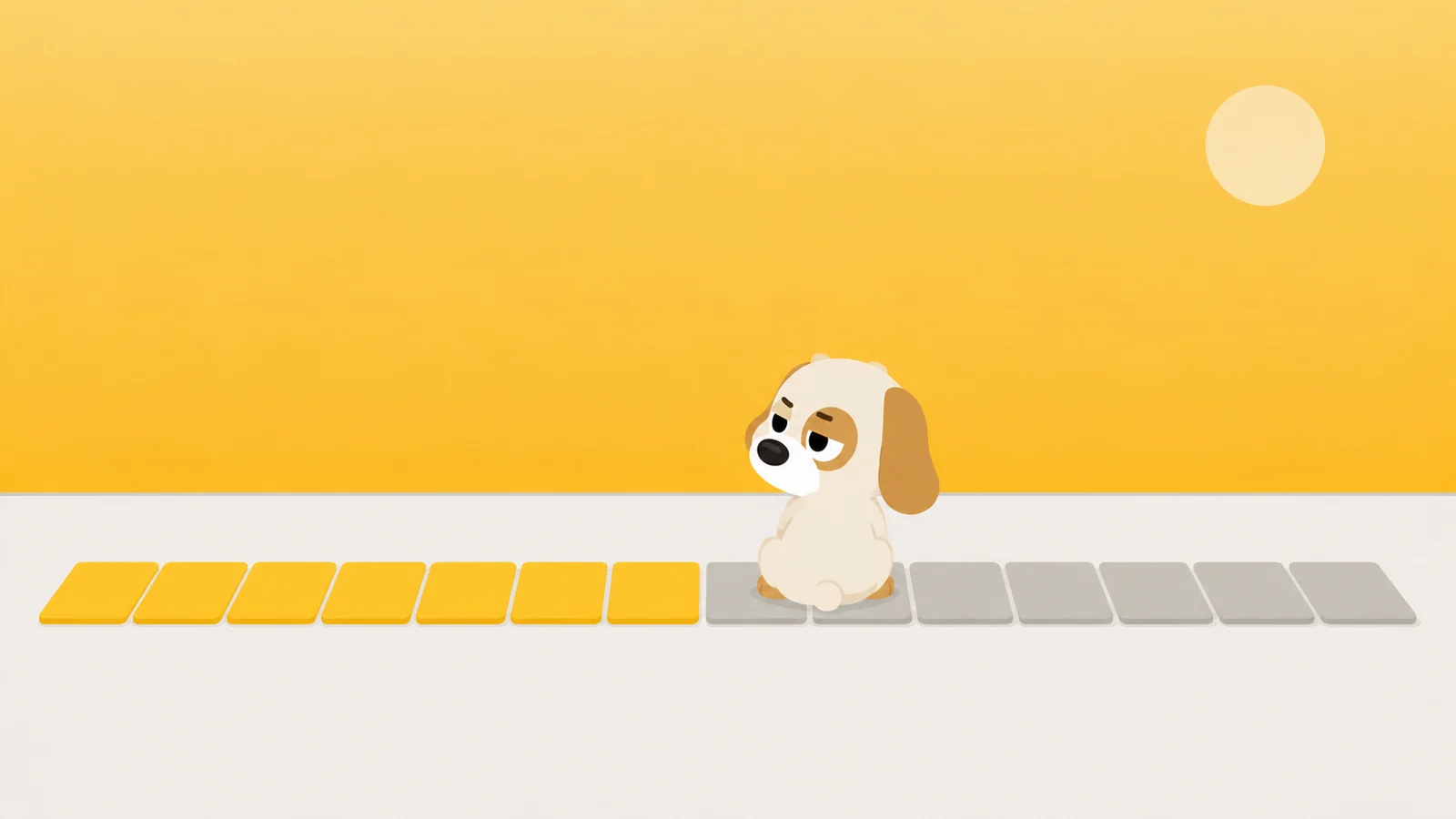
Every dumb phone article you have read ends on day seven.
That is not a conspiracy. Day seven is when the notes are still fresh, the novelty is still doing most of the work, and the piece is due. Week one writes itself. Week two has to be lived through, and by the end of it nobody feels much like writing anything.
So here is week two. We did the swap properly: number moved off the iPhone, iPhone in a drawer, no quiet exceptions on the first night. It came apart in a specific and repeatable way, and the specific part is the only part worth your time.
Week one is real. It is just not evidence.
The euphoria is not marketing. It happens because you have removed the thing your hand reaches for, and a failed reach is memorable in a way a successful one never is. You catch yourself reaching all day and you score every catch as a win. People ask you about the phone, which is a reward of its own.
The other thing about week one is that it happens to contain no logistics. Nothing turned up that week that needed a smartphone, because logistics arrive on a schedule you do not control: the flight, the appointment, the car park that only takes an app, the gate code a plumber sends you while you are out. Seven days is not a big enough sample of an ordinary life. Fourteen starts to be.
Day three feels like proof. Day three is a holiday. Nothing is ever proved on a holiday.
Check one number before you spend money on a second phone
Do this on the iPhone, tonight, before anything else. Settings, Screen Time, See All App & Website Activity. Scroll past Most Used and past Notifications until you reach Pickups, then open First Used After Pickup. It is a ranked list of what you open first, every time you wake the phone. Read the top three names.
If the top three are Messages, Phone and the camera, buy the flip phone. Genuinely, with our blessing. Your reaching is already aimed at things that travel with your number, and the swap will cost you very little.
If the top name is Instagram, TikTok, Reddit, X or your work email, the swap will move the problem rather than remove it. Those do not live on the SIM. They live on an account, and an account will follow you onto any screen in the building. Which is what day eight is about.
Moving the number is harder than choosing the phone
Choosing takes an evening of reading reviews. Moving is the part that bites, because every iPhone Apple has sold in the United States since the iPhone 14 has no SIM tray in it at all. Your number is an eSIM. Getting it into a flip phone that expects a small plastic rectangle is a conversation with your carrier, not a tap, and some of them will want you standing in a shop for it.
Turn iMessage off while the number is still on the iPhone: Settings, Apps, Messages, iMessage off. Then Settings, Apps, FaceTime, off. Skip this and texts from every iPhone user you know keep being routed to a phone that is in a drawer, and you will spend week two being told you never replied. Apple does run a web page that deregisters a number after the fact, and it is a much worse afternoon than the switch.
Day eight: the iPhone came back into the house as an appliance
Not as a phone. As the camera. As the bank's second factor. As the thing with the boarding pass on it. It went on the kitchen shelf, plugged in, and that felt like a sensible compromise for about four days.
Here is the mechanic nobody warns you about. An iPhone with no SIM in it is still an entire iPhone. On wifi it has the App Store, it has iMessage through your Apple ID, and it has every feed you thought you had left. Nothing was removed. The only thing that changed is that the whole internet now lives nine steps away in the kitchen instead of in your pocket.
Nine steps is a real rule for about four days. Then you learn the route.
Nobody put the appetite in the drawer. It has never once been in the drawer.
A drawer is a rule made of distance, and distance is the one rule you get better at breaking.
Nothing about a dumb phone touches the laptop
This is the part the swap cannot even attempt. Two feet away is a machine with instagram.com, x.com, youtube.com and reddit.com on it, none of which need an app, none of which have a limit attached, and none of which will ever show you a grey screen. There is not even the friction of finding an icon. There is a tab, already open, from last Tuesday.
In week one you barely touch it, because week one is a holiday. In week two the browsing moves house, and it moves into the version with a keyboard and no ceiling. If you are going to do this, close those tabs and sign out on the laptop the same afternoon you move the number. It is the cheapest thing in this article and it is the thing everybody skips.
The three things only the smartphone could do
By the end of the second week the list of genuine losses was short, and none of it was the feed.
The second factor. A bank that approves logins with a push into its own app is not going to text you instead, and an authenticator app does not follow a SIM card into a flip phone. So you walk to the kitchen at the exact moment you are doing something responsible, which is also the moment you feel most entitled to be holding the thing.
Photographs, and the group thread. A phone that does not do RCS, and the plain ones do not, drags a mixed thread down to SMS and MMS. Pictures arrive small. A tapback arrives as a sentence. Nobody says anything about this to your face. What happens instead is that after a week or so the plan gets made without you in it, you hear about it late, and everyone is mildly surprised that you did not know.
The one-off. The car park that only takes an app. The menu that is a QR code. The gate code that arrives as a link. Thirty seconds each on a smartphone, a small public humiliation without one, and no way to prepare, because you do not get told which day they are coming.
None of that is weakness. Each one is a moment when going and getting the iPhone is the correct decision. And every one of them ends with you standing in the kitchen at eleven at night, holding the entire internet, with a legitimate reason to be there.
A phone is a switch, and an evening is not
That is the join where the whole thing fails. A dumb phone has one setting, and everything you actually need from a smartphone is a short, boring list. The swap makes you pay full price for that list every single time you need one item off it. Either you go without, which costs you real things like being in the plan, or you go and fetch the phone, which costs you the evening you were trying to protect. There is no middle position. There is no way to buy just the boarding pass.
A switch has two positions. Your evening has about nine.
And then there is the browser. Most of these phones have one, because a phone that cannot show you a bus timetable is not a phone. Somewhere around day ten you will find yourself reading a news site on a two inch screen, not enjoying it, and doing it anyway. That is the moment the experiment tells you what it was actually measuring.
What two weeks leaves you with is four names
The result, if you see it through
The swap tests one idea: that the appetite is attached to the hardware. Week one supports the idea. Week two does not. What you are left holding is a list of the four or five apps you would carry onto any device anybody handed you, in any form, on any screen in the house.
That list is worth a fortnight of inconvenience even if the flip phone goes back in its box on day fifteen.
Four names on a piece of paper do not need a second phone to enforce them. They need the phone you already own to be harder to open for four things and exactly as easy for everything else.
Which is where we admit what we make. Scrappy is a small dog who stands in front of the apps you name, on the phone already in your pocket. He knows three rules and no others: quiet hours, a daily limit, and an open limit, which is a cap on how many times a day you are allowed to look. Everything you did not name stays precisely where it was. The camera, the maps, the bank, the boarding pass, the group thread: none of it goes in a drawer, so there is no route for you to learn.
He is not a timer, either. First knock, he is polite about it. Fourth knock, he is standing on the doorknob with his whole head in it. Getting past him costs a treat, treats come from walking about two thousand steps, and one buys five honest minutes. We have never sold a treat and we never will. You also set how hard he is per app: negotiable opens for a treat, firm makes you sit for ten seconds first, and absolute means he will not take the treat at all.
The two failures above have specific answers, which is the only reason we are bringing him up here rather than at the top. The kitchen at eleven at night has a removal lock, so you cannot delete him and reinstall yourself a clean slate; switching that lock off takes a day, which is deliberately longer than an urge lasts. The genuine emergency has an emergency pass, one a month, no scolding, because sometimes it really is the boarding pass. None of it needs an account, a sign-up or a server of ours. Your Screen Time is drawn by a sandboxed Apple extension that cannot phone home.
He does not fix the laptop. There is a Mac app coming and it has not shipped yet, and until it does we are not going to pretend that half of this article is solved.
We are also not going to tell you whether to buy the flip phone. Plenty of people are happy on one for years. In our experience the happy ones are the people whose First Used After Pickup list was already boring before they started.
What he'd do
- Read your own Pickups list for a week before you spend anything. Settings, Screen Time, See All App & Website Activity, then First Used After Pickup. Seven days of that costs nothing and tells you what a second phone would actually be buying you.
- Write down the things only a smartphone can do for you, on paper, before the number moves. Bank approval, work sign-in, the car, the car park, the door. That list, not the feed, is what ends most of these in week two, and you can shorten it in advance if you can see it.
- Turn iMessage off before the SIM comes out, not after. Settings, Apps, Messages, iMessage off, then the same for FaceTime. Ninety seconds, and it is the difference between going quiet on purpose and going quiet by accident.
Or keep the phone and name four apps.
Free to start, one whole rule, every safety rail. Treats are earned by walking, and we will never sell you one.
Get Scrappy on the App StoreChecked against
- Screen Time paths (Settings, Screen Time, See All App & Website Activity, then Pickups and First Used After Pickup) checked against Apple Support's Screen Time guide for iOS 26 on 26 August 2026, not walked on a handset for this piece. The shape of that screen has not changed since Pickups was introduced in iOS 12.
- iMessage and FaceTime: Apple Support, "Deregister iMessage on your iPhone or online", which gives the in-Settings route (Settings, Apps, Messages) and the web form for after the number has gone.
- Every iPhone model Apple has sold in the United States since the iPhone 14 ships without a SIM tray. Apple's US product and support pages, checked 26 August 2026. Models sold elsewhere still have one.
- The account of week two is the house's own. It is told without any measurement you would have to take on trust, and every mechanism named in it (a SIM-less iPhone remaining a whole iPhone on wifi, a mixed thread falling back to MMS, an authenticator app that does not follow a SIM) is one you can reproduce with the two devices you already own.