
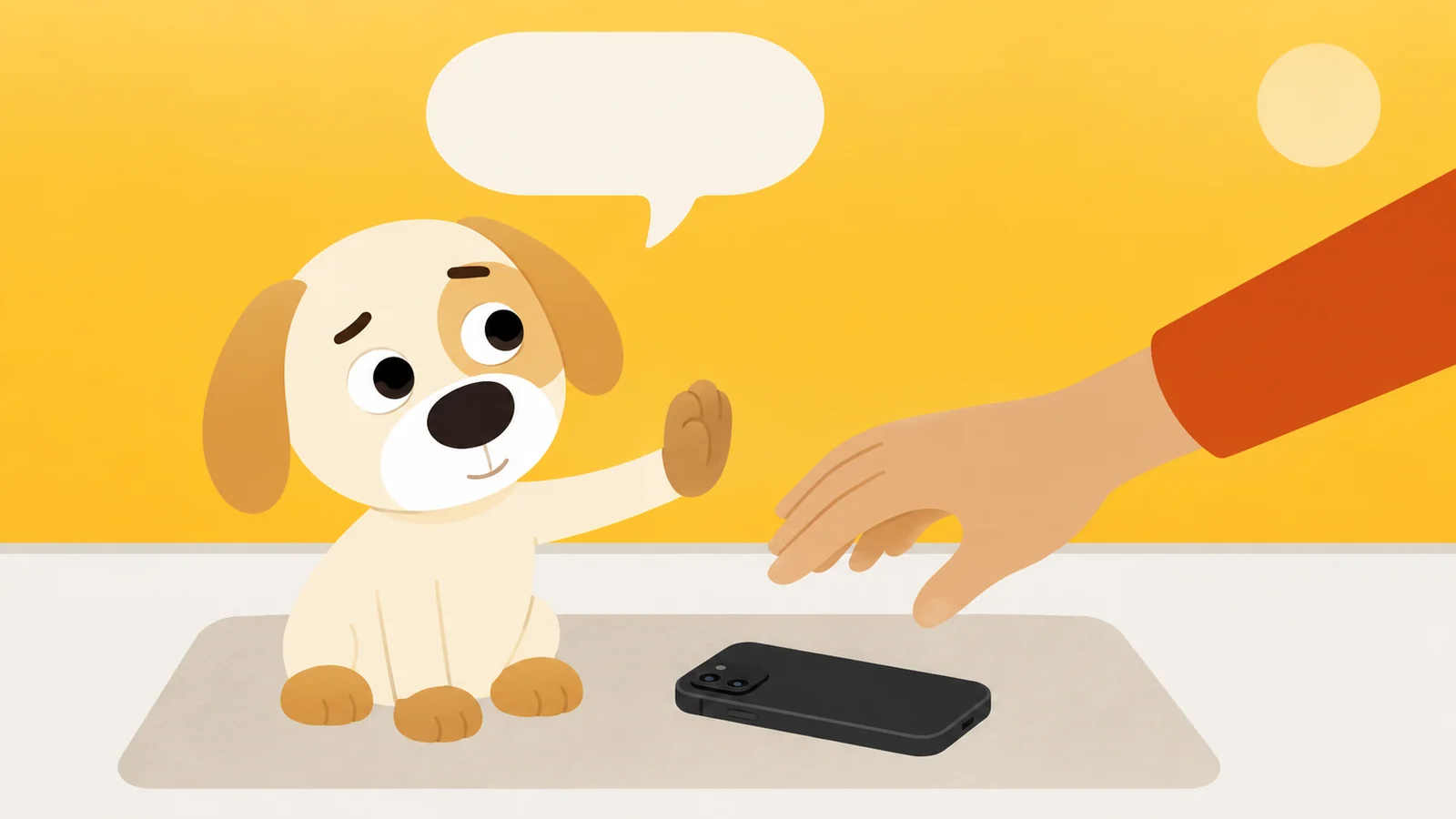
The document has been open since ten, and somehow the phone is in your hand.
You did not decide to pick it up. There was a gap at the end of a paragraph, about two seconds wide, and by the time you noticed anything at all the screen was on, the home screen was showing, and you were already looking around it for a reason to be there.
That last part is the useful part. Almost everybody describes this as picking up the phone for no reason. It is more accurate, and much more actionable, to say that the reason turns up afterwards. The hand goes first. Attention catches up two seconds later and starts shopping for something the hand could plausibly have wanted, and it always finds something, because there are ninety apps on there and one of them is always in a slightly different state than it was.
So here is the test. It is the whole article, if you want to stop after it. The moment you notice the phone is in your hand, finish this sentence, out loud or under your breath:
I picked this up to…
Four seconds, most of them spent waiting to see whether the sentence goes anywhere. It ends in one of three ways, and only one of them is a plan.
The sentence ends three ways and only one of them has an object in it
It fills with an object. Send Priya the address. Check whether the 18:40 is cancelled. An object has an end built into it: you can tell when you are finished, because the named thing is done. Go and do it. Then, and this is the part that takes practice, stop.
It fills with a category. Check my messages. See if anything happened. Have a quick look at email. Categories do not finish. There is no state of the world in which nothing happened, so there is no version of this errand you can complete and walk away from. A category is the habit wearing a coat and using your voice, and it will be your most common answer, which is worth knowing about yourself before you find out the hard way at half past eleven.
It will not fill at all. The sentence just sits there. This is the good outcome, oddly, because it is the only unambiguous one: there was nothing to open it for. Put the phone face down. You have spent four seconds and saved somewhere between two minutes and the remainder of the evening.
You did not decide to pick it up. You noticed you had. Those are different sentences and only one of them has you in it.
Plenty of your pickups have perfectly good objects in them, and a fair number of those objects are your job. The test is not a scoring system and there is no target. It sorts pickups into named and unnamed. What you do about the named ones is entirely your business.
The reach finishes before you get a vote on it
It helps to be specific about what sets it off, because it is almost never boredom in the large sense. It is a gap in the work, and the gaps are small and identifiable: the end of a paragraph. The two seconds after you hit send. The spinner on a page that is loading. The sentence you do not yet know how to finish. A file dialog. The moment a build starts.
Each of those is a hole roughly two seconds wide, and something has been trained to fall into it. Not by you, and not by anybody plotting against you either. It got trained the ordinary way, by paying off often enough.
The reach is also physically shorter than it used to be. Raise to Wake means lifting the phone and turning the screen on are one motion rather than two, and Face ID means the lock screen is no longer a delay: the phone recognises you on the way up. If you want the two motions back, they are at Settings › Display & Brightness › Raise to Wake, and turning it off puts a deliberate button press between the hand and the screen. It is a small thing. It is also the only mechanical step in this whole article.
The number that describes all of this is not hours. It is pickups, and your phone counts them. Settings › Screen Time › See All App & Website Activity, then scroll past Most Used to Pickups. It gives you a total, a per-hour graph, and underneath, First Used After Pickup: which app you went to first each time. That last list is the most honest paragraph anyone has ever written about you.
Total screen time is the number people quote at each other. Pickups is the number that fits this problem, because the cost of mindless phone checking is not really the minutes spent. It is the count of re-entries, each one of which throws away whatever you were holding in your head. If you have never looked at yours, the weekly report is worth twenty minutes of a Sunday.
For scale, the one published figure worth knowing: dscout's 2016 Mobile Touches study put the average at 76 separate phone sessions a day, and 132 for the heaviest tenth of its participants. It was 94 Android users over five days, and it is ten years old. Your own number is on your phone and it is better than theirs.
The two-minute rule was written for a desk, not for a phone
David Allen's version, from Getting Things Done, is one of the few pieces of productivity advice that survives contact with a real week: if a task takes less than two minutes, do it now rather than filing it. It works because the things in a paper inbox are bounded. Signing the form takes forty seconds and then the form is signed.
Run that rule on a phone and it eats you. Everything on a phone takes less than two minutes, and none of it is finished in two minutes. Checking whether Sam replied takes four seconds. What happens in the nineteen minutes after that is not the task, and it never was, but the rule waved you through the door on the strength of the four seconds.
The two-minute rule, for phones
Not if it takes under two minutes, do it now. On a phone the rule has to run the other way: if you cannot name it in under two seconds, it is not a task, and the two minutes it claims to need are not the two minutes it will take.
The strongest objection is that you will never be awake to run it
Which is real, and worth stating at full strength before anybody tries to wave it away.
The reach is defined by happening while you are elsewhere. Asking it to stop and answer a question is asking the part of you that is not present to summon the part that is. If you were present enough to say the sentence, you were present enough not to reach in the first place, so the test only catches the pickups that were never the problem. Every self-monitoring trick ever invented has died on exactly this, usually in week two, and usually while the person blames themselves for it.
Yes. That is the whole problem. A rule that needs you awake is no use at the moment you go under.
The objection is right about the reach and wrong about what comes next. You are not being asked to catch the hand. The window is later: the two to four seconds after the screen is on and before an app is open, when you are standing in your own home screen having chosen nothing yet, waiting to find out what you want. That moment is conscious. Everybody has it. It is short and slightly embarrassing and it is the only part of this you have ever had a vote in.
You do not get to prevent the pickup. You get to end it early. Those are different ambitions and only the second one is on offer.
Which leaves the smaller, more honest version of the objection: you will remember to run the test perhaps a third of the time in week one and less after that. That one stands, and it is not answered by trying harder. It is answered by noticing what the test is actually for. Run it for one day and keep a tally of the two failing endings, the category and the blank. We are not going to guess your number, because it is the one thing here that has to be yours. It will be higher than you expect, and once you have it you stop arguing about whether this is a real problem and start arguing about what to put in the gap.
Whatever goes in the gap has to arrive at the door, not before it
Work backwards from the four seconds and the shape of the answer falls out on its own. It needs four properties, and the built-in tools give you two of them.
Imposed, not remembered. The pause has to happen without you deciding to make it happen, because the deciding part of you is demonstrably asleep at the exact moment in question. Anything that begins with the words "just remember to" is a plan for people who do not have this problem.
Per open, not per hour. Downtime and app limits are schedules. They shut the door between two times, or after so many minutes have been spent. This is not a schedule problem. It is an every-open problem, and the one you want stopped is the fifteenth open of the day at twenty past two, which no clock has any opinion about. There is a real gap here worth naming: Screen Time's App Limits are measured in minutes only. There is no setting anywhere on the phone that caps how many times you may open something, which means the number this whole problem is measured in is the one number iOS will not let you put a ceiling on.
About ten seconds long. Under three and you wait it out the way you wait out a loading spinner, with nothing whatsoever crossing your mind. Past fifteen or twenty it stops being a pause and becomes a wall, and walls get torn down at eleven at night by the same hands that built them. Ten seconds is long enough for a thought to arrive and short enough that you do not resent it afterwards. It does not stop you, and it is not supposed to. It makes you present for the decision, which is all the test ever wanted.
Not dismissible by the same thumb that summoned it. If there is a button that ends the pause, the hand that reached will press the button, and it will press it before you have read the label.
Which is roughly how you end up negotiating with a dog
This is the part where we admit we make one, so treat the rest accordingly. The test above is free and works on any phone and you can leave now with it.
Scrappy is a small scruffy dog who stands in front of the apps you name. He knows three rules and no fourth: quiet hours, a daily limit, and an open limit. The open limit is the one this article has been walking towards, because it counts opens rather than minutes. Six looks a day is plenty, and on the seventh he is at the door.
Every guarded app gets a resistance level, and the middle one is the ten seconds argued above. Negotiable apps open for a treat. Firm apps make you sit for ten seconds first, imposed rather than remembered, long enough to notice you did not really want to open it. Absolute apps he will not open for a treat at all, and he will look at you about it.
Ten seconds is not a punishment. It is how long it takes for the question to catch up with your thumb.
Knock again and he does not repeat himself. He starts polite, gets surprised, goes firm, and by the fourth try he is one word: No. The fifth is theatrically wounded. Getting in anyway costs a treat, and treats come out of real life: roughly two thousand steps of walking earns one, and one buys five honest minutes before he is back on the door. We do not sell them, and we are not going to. That is the only part of the design we would call a promise.
He also has no account, no sign-up and no server of ours to phone. Your Screen Time is drawn on your own phone by a sandboxed Apple extension that is not permitted to send it anywhere. Free Scrappy is one whole rule, uncrippled, with every safety rail: the always-allowed list, the monthly emergency pass, and the removal lock that closes the delete-and-reinstall loophole and takes a day to switch off again, because a day outlasts an urge.
What he'd do
- Run the sentence for one day, and tally only the failures. Not a week. One day, from waking to bed, and you only mark the pickups where the sentence ends in a category or ends in nothing. The number takes no effort to collect and settles the argument you have been having with yourself.
- Read your Pickups, not your hours. Settings › Screen Time › See All App & Website Activity, scroll past Most Used. Look at First Used After Pickup before you look at anything else. That is the list of apps your hand has learned, and it is usually two apps, not ten.
- Open apps by typing, not by tapping. Swipe down from the middle of the home screen and type three letters of the app you want. Naming it is the same test, run again, and it takes you straight past the grid of icons where the grazing happens.
Let somebody else hold the ten seconds.
Free to start, one whole rule, every safety rail. He counts opens, which is the number nothing else on the phone will count.
Get Scrappy on the App StoreChecked against
- iOS 26, iPhone. The Pickups report and the First Used After Pickup list were verified against Apple's own Screen Time documentation and current reporting rather than walked by hand for this piece. On some setups the button reads See All Activity, and where Share Across Devices is on there is an All Devices row to tap first.
- That App Limits are duration-based, with no option to cap the number of opens, is a statement about what the Screen Time settings screens contain. Verified by inspection, not inferred.
- dscout, Mobile Touches, 2016: 94 Android participants, five days, 76 phone sessions a day on average and 132 for the top tenth. Quoted for scale only. It is a decade old and it is not an iPhone study.
- David Allen, Getting Things Done, for the two-minute rule as originally written.
- Four seconds is the length of the sentence, not a measured reaction time, and nothing here rests on it being exact.