
You are reading this indoors, on the phone, having promised yourself an hour outside.
Somebody has told you to touch grass at some point, and they were not being kind when they said it. The phrase means you have been online long enough to lose your sense of scale, and that the cure is to go outside and put your hand on something that grows. Merriam-Webster dates the phrase to 2016, and it has been thrown as an insult nearly every time since.
It is a rude piece of advice, and it is also the only one in this entire genre with a real mechanism behind it. Those two facts sit together badly, which is exactly why the people it would help are the people who dismiss it fastest.
Everything else you have tried subtracts
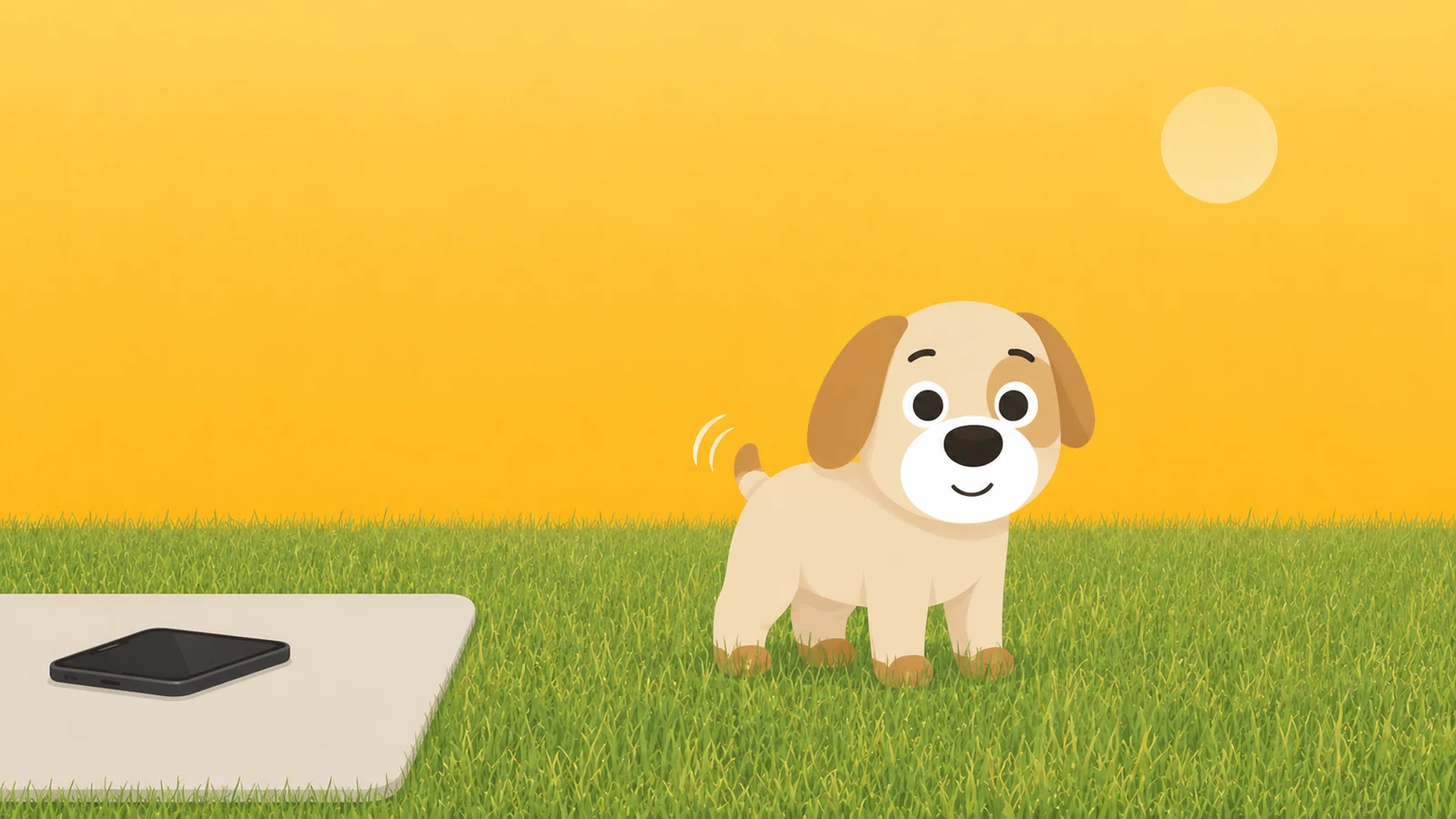
Greyscale. App limits. A home screen with nothing on it. The four worst apps buried in a folder on page three. The wooden box with a timer on the lid. And, since we belong on that list too, a small dog standing in front of Instagram.
Every one of those removes the phone from the situation. Not one of them puts anything into it. And the situation at twenty to ten on a Tuesday is not a supply problem. You are not sitting there wanting Instagram specifically. You are sitting there wanting something, and Instagram is simply the nearest thing that answers on the first try.
Taking the bowl away does not make the dog less hungry. It makes the dog look at you.
So the useful question is not how to remove the thing. It is what the thing is handing you, because whatever takes its place has to hand you the same.
The feed does five jobs, and the fifth one is the bill
Pick the phone up tonight and watch the first ten seconds. Here is what the scroll supplies, roughly in the order you feel it:
- It is ready in under a minute. No equipment, no changing clothes, no booking anything.
- It needs no decision. You do not pick what to look at. It arrives pre-picked.
- It gives your eyes new things. A steady drip of images you have not seen before, which is most of what people mean when they call it addictive.
- It asks nothing of you. No skill, no concentration you have to hold up, no way to be bad at it.
- And it ends with you exactly where you started.
That last line is not a feature, it is the bill. It is why putting the phone down at ten past eleven feels like nothing happened. In the only sense your body keeps score of, nothing did.
Score the usual replacements against those five and most of them are out before the third column.
| Instead of scrolling | Ready in a minute | No decision | New to look at | Asks nothing | Ends elsewhere |
|---|---|---|---|---|---|
| The feed | Yes | Yes | Yes | Yes | No |
| A book | Yes | No | Slowly | No | No |
| A video game | Yes | No | Yes | No | No |
| The gym | No | No | No | No | Yes |
| A walk | Yes | Yes | Yes | Yes | Yes |
One row is clean. It costs nothing, needs no equipment, requires no booking and is available in the clothes you already have on. The book row is the one that stings, because a book is what most people mean when they say they want to stop scrolling, and it loses on merit at that hour for reasons that deserve their own page.
The grass is not the active ingredient
The word grass does damage here, because it implies you need a park, a season and a certain kind of life. You do not. A pavement works. A supermarket car park at dusk works. Whatever is going on between trees and human beings, it is not the thing carrying you at half past nine in February.
There is a whole literature about walking and mood and we are not going to wave it at you, because the argument does not need it to be true. The argument is smaller and much harder to wriggle out of: this is the only thing on the list that matches the feed on every count and is available right now, for free, to a tired person in socks.
A walk is the only feed that leaves you somewhere else at the end of it.
The strongest case against this is that you have heard it a thousand times
Take the objection properly, because it is a good one. Nobody alive is short of this advice. It is free, it is everywhere, your mother has given it to you and strangers have given it to you rudely. Advice with total distribution and no visible result is usually just wrong. That deserves a paragraph, not a shrug.
Then there is the practical half of the objection. People do go. They take the phone, they scroll on the way, and they come home with four thousand steps and no walk. The medicine was administered and nothing happened.
Both are fair. Neither is about walking.
The first is about delivery. "Touch grass" is not an instruction, it is a verdict on your character handed down by a stranger in a reply. Nobody in the history of the internet has rearranged an evening because someone implied they were pathetic. "Go outside more" is barely better, because it is a wish: no distance, no time, no destination, and not one word about where the phone goes. Wishes lose to defaults every single night, and the default is already in your hand.
A walk with the phone in your hand is just the phone, outdoors.
The second is about where the phone is, and where the phone is turns out to be most of the instruction.
Decide where the phone goes before you open the door
Three versions, best first:
- On the hall table. Nothing counts it, nothing records it, nobody hands you credit for it, and it is still the best one.
- Zipped into a bag, or in the back pocket you cannot reach while walking. Anything that puts a second deliberate movement between your hand and the screen. This is the version people actually do.
- In your hand. Not a version. Start the podcast before you leave and then put the phone away, because a phone held for a podcast becomes a phone held for a feed, and it does not take long.
Then the number worth knowing. Two thousand steps is about a mile, and about twenty minutes at an ordinary pace. That is the unit. Short enough to start on a bad night, long enough that you come back into a different evening from the one you left.
Whether twenty minutes is the right length for you is the same question people ask about work, and it has the same answer: take the length from what you are doing, not from a round number somebody printed on a timer.
One more specific, and it is the one that decides whether any of this happens at all. Give the walk a job. "Go for a walk" gets rescheduled. "Go and post this" gets done. Pick something you have to physically arrive at: a postbox, one item from one shop, the bench at the far end of the park. The errand does not have to be worth doing. It only has to be somewhere.
The first five minutes are the entire tax. Nobody has ever been four minutes into a walk and enjoying it. Everything after that is free.
The argument, compressed
Every screen-time tool subtracts, and the evening was never short of supply. A walk is the only ordinary thing that matches the feed on all five counts and still leaves you somewhere else.
Which is also why knowing that has never once been enough. The useful move is not more knowing. It is making something you already want cost a walk.
Nothing above will make you go, which is the actual problem
Every word so far is true and none of it is a reason. You already knew walking was good for you. You have known for years. Knowing has never got a single person off a sofa at twenty to ten.
What does move people is contingency: making the thing you want depend on the thing you will not do on its own. Not as self-improvement. As a fee.
And at twenty to ten, the thing you want is fifteen minutes on the app you shut. That is the item with a price on it. So charge for it in steps.
Which is, more or less exactly, the app we make. Scrappy is a small dog who stands in front of the apps you name. Getting past him costs one treat. One treat costs about two thousand steps, walked, outside, by you. It buys five honest minutes, and then he is back at the door.
Treats cannot be bought. Not for a pound, not for fifty, not ever. That is not a revenue line we are being noble about. It is the only version of the deal that means anything, because the moment a treat has a price in money the price stops being a walk, and the whole thing is a paywall with a dog drawn on it.
Two thousand steps. I do not take cash.
There is also a walk inside the app, which is a named session of anywhere from twenty-five minutes to eight hours where he guards everything while you are out, with a Live Activity on your lock screen. The pun is not an accident. And every guarded app gets a resistance level, so the ones you are negotiable about open for a treat, the firm ones make you sit for ten seconds first, and the absolute ones he will not open for any number of steps at all. That last setting exists because most people have one app that no amount of walking should buy.
The pet apps arrived at part of this before we did, and they got something real: caring about a small thing beats caring about a number, every time. They deserve the credit for it. Where the trick runs out is that a tree grows whether or not you actually did anything. A dog notices.
And the honest edge of our own mechanic, since we are here. Leave the phone on the hall table, which is the best version of the walk, and unless there is a watch on your wrist nothing counts a single step of it. He would tell you to go anyway. The treat was never the point. It is just how you get a tired person as far as the door.
What he'd do
- Give the walk a job before you give it a time. A postbox, one item from one shop, the bench at the far end. Two thousand steps is about a mile and about twenty minutes. Errands get done, walks get rescheduled.
- Decide where the phone goes while you are still standing at the door. Hall table, zipped bag, or back pocket. Decide it once, as the person who wanted to go, not four minutes in as the person who is bored.
- Put your own two numbers side by side. Open Health, tap Browse, then Activity, then Steps, and read last week. Then Settings, Screen Time, See All App & Website Activity, and scroll down to Pickups for the same week. You do not need a theory. You need last Tuesday.
He does not take cash.
Free to start, one whole rule, every safety rail. A treat costs about two thousand steps and has never been for sale.
Get Scrappy on the App StoreChecked against
- Merriam-Webster's entry for touch grass, which records a first known use of 2016. Read 26 August 2026.
- The two paths in the payoff box were confirmed against Apple's own Health and Screen Time documentation and current iOS 26 write-ups on 26 August 2026, rather than walked on a handset for this piece: Health, Browse, Activity, Steps; and Settings, Screen Time, See All App & Website Activity, then Pickups.
- Two thousand steps to roughly a mile is arithmetic on an ordinary adult stride, not a study. Your own stride will move that figure in either direction, and it does not change the argument.
- No claim about walking and mood is cited here because none is made. Everything above rests on what is available to you tonight, not on physiology.