
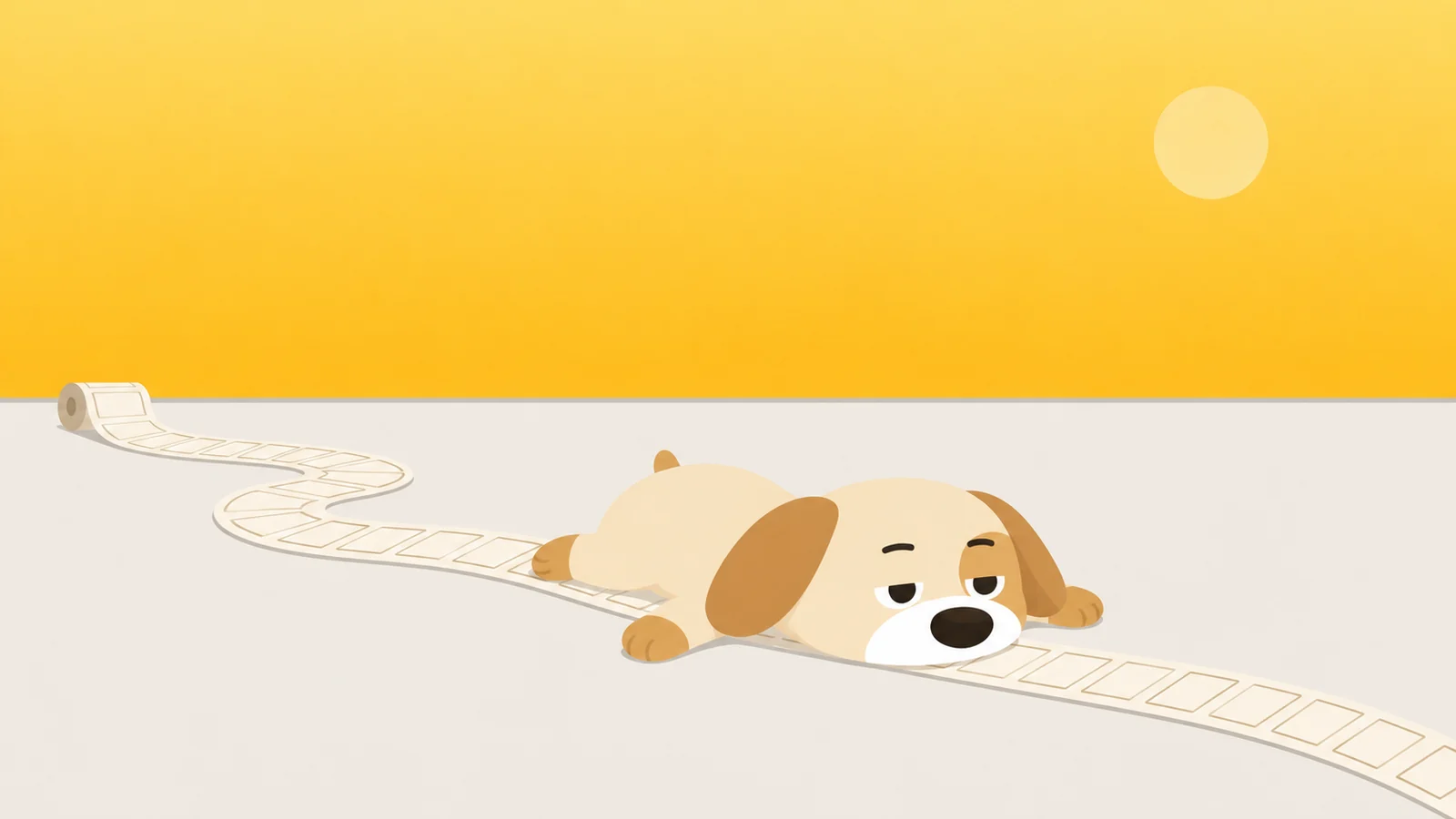
You lost an hour last night and you cannot name one thing you saw.
There is a word for that now. In December 2024 Oxford University Press made brainrot its word of the year, which is normally how a word dies. This one survived it. People still say it, mostly about themselves, mostly as a joke, and the joke keeps landing, which almost never happens unless something true is underneath.
What it describes is narrower and more useful than the coverage made it sound. Brainrot is not a claim about your brain. Nobody is offering you a scan. It is a claim about how much of an evening came back out of an evening, and that is the only claim in this entire subject that you can check for yourself, tonight, without anybody's permission.
So check it first, and read the rest afterwards.
The test takes two minutes and everything after it is easier
Pick the app you already suspect. Do not open it. Get a piece of paper, or the back of an envelope, and give yourself two minutes to write down everything you actually saw in it yesterday.
Not categories. Items. The one about the man rebuilding a kitchen sink. The argument in the comments underneath the sink. Somebody's baby. Whatever is genuinely still there.
Most people get four to six. A bad night gets two.
Now go and get the denominator. Settings › Screen Time › See All App & Website Activity, then tap Day and step back to yesterday. Read the minutes next to that app. If the screen is empty, App & Website Activity was never switched on, which is its own kind of answer.
Divide the minutes by the number of things on your paper. Ninety-one minutes and four items is twenty-three minutes per thing you can prove you saw.
Twenty-three minutes each. I have buried bones I remember better than that.
Then run the same test on the film you watched on Sunday. You will not need the paper. You could tell somebody the plot, and you could do it in the queue at a shop, six days later, without preparing.
The word is not about how long you looked. It is about how little came back.
Brainrot is a hundred and seventy-two years old, which nobody expects
Thoreau got there first. The line is in the last chapter of Walden, published in 1854, and it is exactly as smug as you would expect: England was pouring effort into curing the potato rot, and he wanted to know why nobody was working on the brain rot, which he thought was doing far more damage and doing it faster.
He was being insufferable about people reading easy books. He was also, irritatingly, describing something.
Oxford's definition, published when they handed the word its year, comes in two halves. The first is the state: a supposed decline in someone's mental sharpness, brought on by taking in too much that is trivial. The second half is the interesting one. The word also means the material itself.
That double meaning is the most honest thing about it. Brainrot names the food and the illness with a single word. Nobody calls beer cirrhosis. But a feed is not a substance you swallow and then suffer from later. The watching and the cost are the same forty minutes, happening simultaneously, and one word for both is not sloppiness. It is precision.
Which is why the content that gets called brainrot was named that by the people who make it and watch it, not by a critic. Skibidi Toilet. Italian brainrot. Whatever has replaced them by the time you are reading this. Those are self-descriptions, worn cheerfully, by an audience naming a genre after its own effect. That is not what a moral panic sounds like from the inside.
The best argument against everything above, put as strongly as it deserves
Every generation invents a word for whatever the next one enjoys, and most of those words look ridiculous inside thirty years.
Socrates thought writing would hollow out memory, on the grounds that a man with notes stops needing to know things. The eighteenth century worried about novels in the same tone we now use about short video, with the same certainty about what they were doing to young women. In 1954 a psychiatrist named Fredric Wertham published a book blaming comics for juvenile delinquency, a US Senate subcommittee took him seriously, and the American comics industry spent three decades censoring itself as a result. Then television. Then video games. The list is long and its record is poor.
The numbers do not rescue us either. In 2019 Amy Orben and Andrew Przybylski put the question through three large datasets, 355,358 people in total, and published in Nature Human Behaviour. Technology use accounted for at most 0.4% of the variation in adolescent wellbeing. To show what that size of effect looks like, they ran a few other things through the same data. Regularly eating potatoes was almost as negatively associated with wellbeing as screens were. Wearing glasses was worse.
I have no opinion about the novel. I have several about last Tuesday.
That argument is right about everybody and silent about you
Take the potato finding seriously. It is careful work and it has survived people trying to knock it over. What it says is precise: across a large population, the number of hours a teenager spends on screens tells you almost nothing about how that teenager is doing. Anybody showing you a graph of teenage unhappiness laid neatly over smartphone sales is showing you a graph.
Now notice what it does not say, and structurally cannot.
Nobody has ever said brainrot about a generation. They say it about last Tuesday. It is a first-person report, filed by the only person alive with access to the data, about one evening they can still half remember. A population average has nothing to tell you there, in the same way that average life expectancy has nothing to tell you about your knee.
And that first person is the entire reason the word travelled. Every previous panic word pointed downward: adults at children, this is ruining them. Brainrot points at whoever is speaking. It is a confession wearing a joke, and a confession wearing a joke costs nothing to make, which is why several million people made it in the same eighteen months.
A word people will use about themselves is worth ten that only work as accusations.
The clinic has no word for this, and that is not the clinic's fault
Go looking for the official version and you will find gaming disorder, which is a real diagnosis in the World Health Organization's ICD-11. The American manual, DSM-5, keeps internet gaming disorder parked in the section for conditions that need more research before anyone commits to them.
Both are about games. Neither system has a diagnosis for scrolling. Not social media, not short video, and certainly not the specific business where you pick the phone up to check the time and put it down at ten past.
So the everyday vocabulary an adult actually has is two words, and both are the wrong size. There is screen time, which is a quantity, and quantities embarrass nobody, because six hours of writing and six hours of Reels are the same six hours. And there is addiction, which is enormous, clinical, and instantly turns the conversation into a debate about whether you technically qualify, instead of a conversation about Tuesday.
Brainrot is the right size. Smaller than a diagnosis, larger than a shrug. It fits one evening, it is funny enough to say out loud in front of people you like, and there is no doctor in it.
What the word actually claims
Not that your brain has been damaged. There is no test for that and nobody serious is offering one.
That a quantity of time went in, and almost nothing came back out, and you noticed.
That the only relevant evidence is your own evening. Nobody else's average is admissible.
Whether it is happening to you comes down to two questions, and neither is hours
The first is the ratio you worked out at the top. Minutes in, per thing you can name afterwards.
The second is about how the session began rather than how it went. Think back to the last five times you opened that app. How many started with an actual sentence in your head, "I want to see if Dan replied", and then a tap? And how many the other way round, where the tap came first and the reason arrived afterwards to keep it company?
Three honest places to land:
- You can account for the time, and you chose to spend it. That is a hobby. Hobbies are allowed. Go and enjoy it and stop reading articles like this one.
- You can account for roughly half. That is nearly everybody, and it is not an emergency. It is a thing to keep an eye on, the way you keep an eye on a tyre.
- You mostly cannot say how the session started, and afterwards there is nothing to report. That is the state the word was invented for. Noticing it is not nothing. It is the whole first step, and most people never take it.
None of that is a diagnosis, and this page is in no position to give you one. If the thing bothering you is bigger than apps, then apps are not the size of the answer, and the person to talk to is a person.
You cannot catch this while it is happening, and that is the problem
A memory failure has one awkward property: it is invisible from the inside. You do not experience twenty unaccounted minutes. You experience nothing at all, and then it is 12:40, and those minutes are not so much missing as never filed in the first place.
So every plan that depends on you noticing at the time is asking the broken part of the evening to fix itself. "I'll just be more aware of it" is not a plan. It is the exact thing that already failed, restated as a resolution.
You will not catch it. You were not there. That is what the word means.
What can work is something arranged earlier, by the version of you who could still count, and still standing there later when you cannot. The phone ships with some of this: app limits, downtime, a passcode. It also hands the keys straight back, because iOS is right to believe that the person tapping Ignore Limit owns the phone. The owner at nine in the evening and the person at 12:40 have the same face, the same fingerprint and the same four digits, and only one of them gets a vote.
Which is the part where we admit we make an app about this. Scrappy is a small dog who stands in front of the apps you name. He knows three rules and no others: quiet hours, a daily limit, and a limit on how many times a day you may open a thing. He gets less patient every knock, from polite to surprised to firm to a single word. Getting past him costs a treat, and treats come out of walking, about two thousand steps for one. They are not for sale, and they never will be.
The part that matters for this article is much smaller than any of that. Apps you mark as firm make you sit for ten seconds before he will even consider it. Ten seconds is nothing. It is also, on the kind of evening described above, the only ten seconds in which you are demonstrably present for the decision, which is the first thing brainrot takes off you.
What he'd do
- Run the recall test tonight, on paper, before you look at the number. Two minutes. In the other order you will cheat, and you will not even notice yourself doing it.
- Turn notifications off for the single worst app. Off, not Quiet. A good share of the sessions you cannot account for never began with a decision at all. They began with a buzz, and a buzz is somebody else choosing when your evening ends.
- Finish the sentence before you tap. "I am opening this in order to ___." If you cannot fill in the blank, you have just caught one live, which is more than any test can do for you afterwards.
Somebody has to be present for the decision.
Free to start, one whole rule, every safety rail. Treats are earned by walking and are never sold.
Get Scrappy on the App StoreChecked against
- Oxford University Press, Word of the Year 2024, announced 2 December 2024: the two-part definition, the 230% rise in usage between 2023 and 2024, and the Thoreau citation. Read 26 August 2026.
- Henry David Thoreau, Walden, 1854, final chapter. The potato rot line is his, paraphrased here.
- Amy Orben and Andrew Przybylski, "The association between adolescent well-being and digital technology use", Nature Human Behaviour, 2019. n = 355,358, at most 0.4% of variance. The potato and eyeglasses comparisons are theirs, not ours.
- WHO ICD-11 (gaming disorder) and DSM-5 Section III (internet gaming disorder, listed as a condition for further study). Neither manual carries a disorder for scrolling.
- Fredric Wertham, Seduction of the Innocent, 1954, and the US Senate Subcommittee on Juvenile Delinquency hearings of that year.
- The Screen Time path was checked against Apple's own iPhone User Guide for iOS 26 rather than walked on hardware for this piece. The labels are See All App & Website Activity and the Day and Week toggle inside it.