
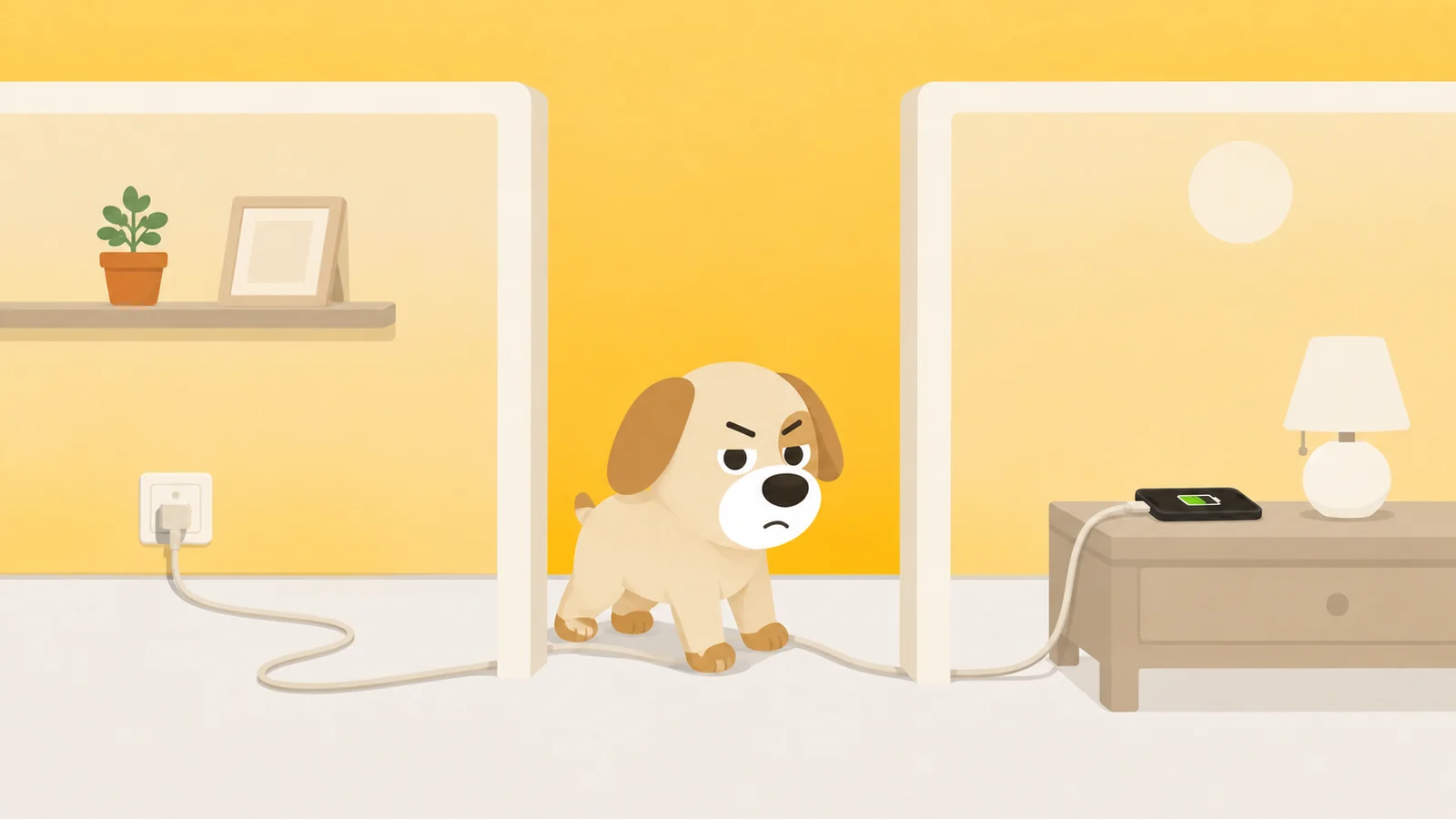
The phone is charging in the kitchen and you are in the kitchen.
Charging your phone outside the bedroom is the first item on every sleep list ever written, ahead of the blue light and ahead of the paperback, and it is sound advice in the way that "spend less than you earn" is sound advice. So we ran it properly. Eleven consecutive nights, one iPhone, one kitchen counter, and a paper notebook by the bed, because writing the night down should not require the object we had just carried out of the room.
It held for three nights. Night four is where this article comes from.
Before any of the story, the useful part, in case you are about to try this tonight: put a clock in the bedroom before you move the phone out. Not a phone displaying a clock. A clock, the kind that only knows what time it is. Every failure across our eleven nights ran through the fact that the room no longer contained the time.
The other number worth having is nine seconds. That is how long it took to walk from the pillow to the counter, barefoot, in the dark. Go and time your own before you read on. It is the entire argument and it costs you a minute to get.
Phone on a charger in another room from the last thing at night until the alarm. Nothing else changes for the first four nights, because if you change five things at once you will not know which one worked. Notebook and pen on the bedside table. Each morning, write down three things: whether you got up in the night, what you got up for, and what you changed afterwards. The third column is the one that turns out to matter.
Nights one and two worked, which is why the advice exists
They were exactly as advertised. Asleep sooner, both nights. Awake once, briefly. And a dull twenty minutes at the start of each night where the hand keeps going out to a bedside table with nothing on it, which is worth warning people about, because it is the bit most people quit over. It fades by about night three.
Two good nights is enough to write a blog post about. It is not enough to know anything. The advice is not wrong. It is just usually published on the morning of night three.
The alarm was in the kitchen, so the alarm stopped working
An iPhone alarm sounds even when the phone is muted and even while a Focus is running. Silent mode has never applied to alarms and this is one of the few Apple decisions nobody argues with. What it cannot do is get through two closed doors and a hallway.
So on night three the phone moved off the kitchen counter and onto a shelf in the hall, with the bedroom door left open a hand's width so the alarm could be heard. The walk was now five seconds instead of nine.
The first repair made the plan weaker. That is a pattern, and it runs through the rest of the list.
Night four went wrong at ten past three
Awake. Properly awake, the way you are when there is no obvious reason for it. The only question in your head at that hour is how much of the night is left, because that is what decides whether it is worth trying again or whether you may as well get up and start.
There was no clock in the room. We had taken the clock out on purpose, eleven days earlier, without ever noticing it was one.
Five seconds down the hall. The phone was face up on the shelf and the Sleep Focus had done its job properly: the Lock Screen dimmed and stripped back, nothing making a sound. It had also been quietly stacking up the notifications it had correctly declined to wake anybody for, and they were sitting there in a pile underneath the time.
Back in bed at eight minutes to four. Thirty-seven minutes, not one of which was spent deciding to break the rule, because the rule was never the thing that broke. The phone was picked up to answer a question that only the phone could answer.
You did not go for the phone. You went for the time. The phone is only where you keep the time.
Charging the phone outside the bedroom moves the object, not the person
Distance is a barrier that charges you in seconds, and at three in the morning seconds are the one currency you are absolutely loaded with. Nothing is competing for the next minute. Nowhere to be. A perfectly reasonable errand in front of you.
Friction you can walk to is not friction. It is an errand, and you are awake anyway.
The high shelf works on biscuits for about a week, and it works because of the chair. Then one evening you get the chair, and after that the shelf is simply where the biscuits live. Nothing about the shelf changed.
You did not fail a test of character. You walked nine seconds, which is what legs are for.
An alarm clock instead of the phone is the cheapest thing in this article
From night five there was a clock in the bedroom, and it is the only change out of eleven nights that never had to be repaired afterwards.
What to look for is narrow. It should show the time, dimly, without being asked, and it should be incapable of anything else. No radio. No Bluetooth. No ceiling projection. Above all no USB socket on the back, because a clock with a charging port on it is a dock, and a dock is an invitation.
The shape of this is the part the lists skip. The reason a phone is on your bedside table is usually not the scrolling. It is the alarm and it is the time, two real jobs that the phone happens to be excellent at. Take the phone away without replacing the jobs and you have not built a barrier. You have built an errand with an unanswerable excuse attached to it.
Apple, for what it is worth, agrees about what a phone is for at night. Leave an iPhone charging on its side, locked and still, and iOS turns it into StandBy: a large, dim bedside clock, with a setting under Settings › StandBy › Display to stop it timing out at all. It is a genuinely good clock. It is also two centimetres from every app you own.
The eleven nights, as they were written down
| Night | What happened | What changed after |
|---|---|---|
| 1 | Slept. Reached for an empty bedside table twice. | Nothing. |
| 2 | Slept. Less reaching. | Nothing. |
| 3 | Nearly slept through the alarm, two doors away. | Phone moved to the hall. Walk down to five seconds. |
| 4 | Awake at 3:10. No clock in the room. Up for 37 minutes. | A clock went in the room. |
| 5 | Slept. | Nothing. |
| 6 | Slept. | Nothing. |
| 7 | Awake at 1:20. The iPad was on the nightstand for reading. Twenty minutes. | Two apps came off the iPad. |
| 8 | Slept. | Nothing. |
| 9 | Went to the hall at 11:40pm about a message that had already been answered. | Notifications off, not quiet, for the two worst apps. |
| 10 | Slept. | Nothing. |
| 11 | Awake at 2:00. Looked at the clock. Went back to sleep. | Nothing. |
Nights five to eleven were mostly about the other screens
Night seven is the one worth copying out. There was an iPad on the bedside table because the plan was to read more, and an iPad is a book that can also do the other thing. It has the same four apps on it. It has none of the limits, because Screen Time rules do not follow you from device to device unless Share Across Devices is switched on in Settings, Screen Time, and hardly anybody has switched it on.
The bedroom had not become screen free. It had become phone free, which is a much easier thing to be and a considerably less useful one.
What actually held
Two things, out of eleven nights and four rearrangements of furniture.
The clock held, completely. And the settings held on the nights they had been bothered with: notifications turned off rather than merely made quiet, two apps taken off the iPad entirely, a real limit with a real passcode behind it. None of those require moving anything, and there is a whole piece on the six settings that change the hour after ten if you want them ranked.
What did not hold was distance. Three broken nights out of eleven, and on every one of those nights the phone was where the advice said to put it. It never mattered. It was never further away than a walk, and a walk is not a wall.
What the eleven nights were actually measuring
Every barrier in that experiment was one we could pay for in the dark: nine seconds, then five, then a second device already in the room, then a door left open so an alarm could be heard through it.
Not one of them asked for something we could not produce at three in the morning. That is the only kind of barrier that would have held, and no arrangement of furniture is capable of building one.
Which is roughly why we ended up making an app about this rather than a piece of furniture.
Scrappy is a small dog who stands in front of the apps you name. Quiet hours is one of his three rules: the door is shut between two times you choose, and at ten past three he is on the other side of it, unimpressed, getting less patient the more times you knock. Getting past him costs a treat. A treat costs roughly two thousand steps of real walking, and cannot be bought at any price. We will never sell them, which matters most at exactly the hour this article is about, because at three in the morning your step count is zero and so is your leverage.
The part that follows from night four is what he leaves alone. He does not make the phone go dark. The clock still works, the alarm still works, the torch still works. What is missing is the four apps you named, which were the four eating the night in the first place. So the phone can stay on the bedside table doing the two jobs it was really doing at ten past three, and the walk down the hall stops being a question, because there is nothing at the end of it.
He is not a cure and he has no opinions about your sleep. If tonight's plan is to delete the whole arrangement and rebuild it in the morning, the removal lock closes that door, and switching it off takes a day, which is deliberately longer than an urge lasts. There is one emergency pass a month for the night you genuinely need the thing, and he does not scold you for it.
What he'd do
- Get the clock before you move anything else. Cheapest item here, and the only change in eleven nights that never needed repairing. It should tell the time and be physically incapable of doing anything else.
- Time the walk, tonight, before you commit to a fortnight of this. Nine seconds in a flat, under thirty in most houses. If your number is small, distance is not your plan, and knowing that now saves you the fortnight.
- Deal with the second screen, or admit the plan was only ever about the phone. The iPad on the bedside table has the same apps and none of the rules. Take two apps off it. Not all of them. Two.
Or leave the phone where it is, and put a dog in front of the apps.
Free to start, one whole rule, every safety rail. Treats are earned by walking and are never sold.
Get Scrappy on the App StoreChecked against
- Eleven consecutive nights in August 2026: one adult, one iPhone on iOS 26, notes written on paper each morning. One household is not a study and we are not dressing it up as one. The parts worth copying are the measurements, and you can take those in your own hallway in about a minute.
- Apple Support, read on 26 August 2026: Use StandBy to view information at a distance while iPhone is charging, which is where the Settings, StandBy, Display timeout options come from, and Turn your Sleep Focus on or off on iPhone, for the simplified Lock Screen.
- Alarms sounding through silent mode and through a Focus, notifications being delivered quietly rather than dropped while a Focus runs, and Share Across Devices living in Settings, Screen Time, are long-standing iOS behaviour and were taken as read here rather than retested for this piece.