
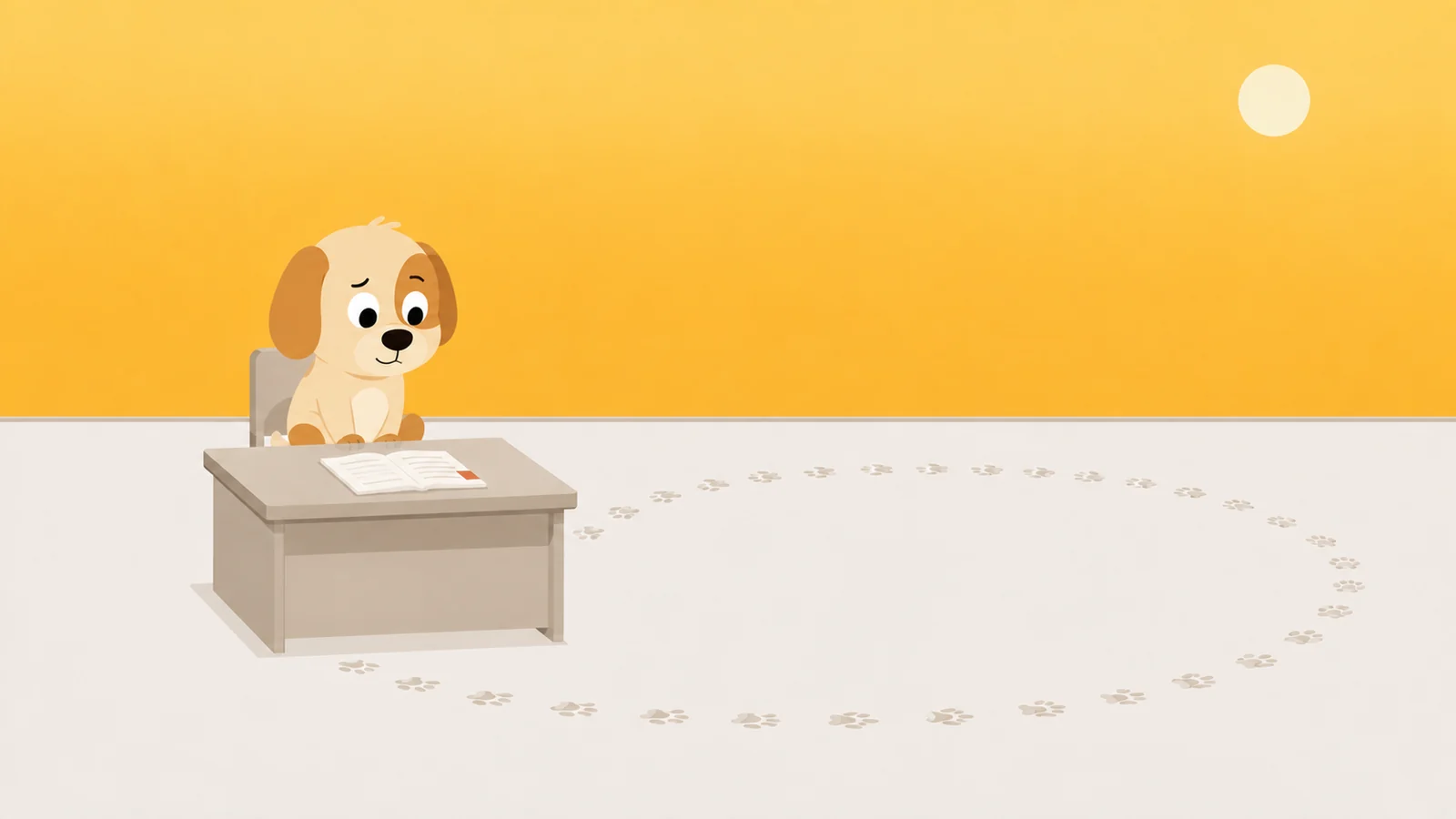
The document has been open since ten and it is now quarter past three.
You have not been idle. You answered eleven messages, read a long thread about a decision that is not yours to make, approved something, looked up a flight for October, and made a genuinely good point in a channel where it was needed. Busy but not productive, and the two are easy to confuse, because from the outside they are identical and from the inside they are worse than identical. They are both tiring.
You never stopped working. You just stopped doing the work. Those are different things, and the difference is not effort. You spent the effort. You spent it on the other side of the desk.
The usual answers to why you get distracted at your desk are that you have a short attention span, that phones rewired your brain, or that you need a better system. None of them survive contact with the evidence, which is that you read four hundred pages of a novel last month, sat through a two hour film without checking anything once, and concentrated extremely hard on that thread for eleven minutes. Attention was not missing. It was somewhere, doing something, on purpose.
So here is the test, and it takes about four seconds. Do not look at the document. Say out loud what the next sentence is. Not what the document is about, not when it is due: the literal next sentence, or the next line of code, or the next number that goes in the cell. If it comes out of your mouth, you took a break, and you can go back whenever you like. If nothing comes out, you did not take a break. You left.
You did not leave because the work was boring. You left because it went quiet.
A break has a return address. A drift is what happens at the exact moment the work stops telling you what to do next and the next instruction has to be supplied by you. That is the whole argument. Everything below it is a defence.
You were not being lazy. You were lost, and the tab knew exactly where it was going.
The moment you leave is never the moment you think it is
Go and find your last switch. Not the last hour, the actual instant your hand went to the other window. Almost nobody drifts in the middle of a sentence. You drift at a seam: after the save, after the send, after the test goes green, after the call ends, after the paragraph lands and the next one has not been decided on yet.
A seam is about two seconds long. In those two seconds the work is issuing no instructions, and the next one has to be written by you, and writing it is the hardest single act in any thinking job, which is why it never appears on a to-do list. The switch happens inside those two seconds. It happens before the sentence I will just check has finished forming. The hand gets there first and the reason catches up afterwards, sounding perfectly sensible.
Nobody decides to open it. The hand goes, and then the head writes the note explaining why the hand went.
Count your own seams for one day and the arithmetic gets uncomfortable quickly. A seam every twenty minutes across a seven hour day is twenty-one of them. You do not lose all twenty-one. Lose a third, at nine minutes each, and the afternoon you have been looking for is the one you already spent. Use your real numbers instead of mine. The point is that the answer is never small, and it is never explained by laziness.
There is a famous figure of twenty-three minutes to get properly back on task after an interruption. It is real, and it is more complicated and rather worse than the headline version, which is why it has a piece of its own. Nothing here needs it. Your own number will do.
Everything you drift to has the next move built into it
Look at where you actually go, because the pattern is not fun. You do not go and play a difficult game. You go to a feed, or an inbox, or a chat.
The next action in a feed is scroll. The next action in an inbox is open the top one. The next action in Slack is the bold thing. Every one of those places decides your next move for you and delivers it on time, indefinitely, at whatever rate you will accept. That is the actual product, and it is not entertainment. It is the removal of the exact thing that went missing at the seam.
Which explains the strangest part of the day, the part that convinces people they are broken: it felt like working. You were reading, replying, judging, holding context, deciding small things. All of the motions, none of the movement. That is what working and not getting anything done is made of, and it is why you are tired at quarter past three and cannot point at anything.
The strongest version of the objection, which is that this is simply how attention works
Here is the best argument against everything above. It is a good one, so it is worth putting properly rather than knocking over.
Nobody concentrates for seven hours. Nobody ever has, and the people who claim to are counting their email as concentration. Attention is not a tap you turn on. It runs down, it needs to wander, and the wandering is not waste: the answer to the thing that beat you at eleven arrives in the shower at seven precisely because you let go of it. On that account the drift is not the disease, it is the recovery, and this article is one more voice telling an exhausted person that they are doing exhaustion wrong.
Take all of that. It is true, and the seven hours part is truer than most writing about work will admit.
The step that fails is the last one, and it fails on something you can check tonight with no equipment. A wandering mind and a scrolling mind are not the same organ doing the same job. The shower works because nothing is arriving. Attention is unoccupied, so it goes off and does its own filing. A feed is the opposite condition: continuous input, arriving at a tuned rate, assembled by people who are very good at their jobs. You are not resting attention there. You are renting it out.
The tell for this one is how you come back. Forty minutes of walking and you sit down able to begin. Forty minutes of scrolling and you sit down feeling like you have already worked and now have to work again. That second feeling is not guilt. It is accounting.
| A break | A drift | |
|---|---|---|
| How it starts | You decide to stop | The work goes quiet and you are already gone |
| What you left behind | The next sentence | Nothing you can name |
| How it ends | At a time you set | When something else interrupts it |
| How you come back | Able to start | Feeling like you already worked |
A walk is a break. A feed is a shift you forgot to invoice for.
The hard version, where the drift has your job inside it
The objection I cannot wave away is that some of this genuinely is the work. Your team is in Slack. The thread that is not yours might be yours by Thursday. Somebody is actually waiting on you.
All true, and the tell still holds, because the tell was never about which app it was. If you can say what you opened Slack for, it is work. If you opened it to find out whether anything had happened, that is not work. That is a doorbell you keep ringing yourself to check that it still rings.
Timers guard the middle of the block. You leave at the edge.
This is where the standard advice runs out, and it runs out in a specific place rather than generally. A twenty-five minute timer puts a fence around the middle of a stretch of work, and it is a good fence. But go back to where you actually go over. Not minute twelve, in the thick of it. Minute six, when the paragraph ended. And minute twenty-five, when the timer said stop and did not say what to come back to. The technique is not wrong. It is defending the wrong two seconds, which is an argument with a piece of its own.
Willpower has the same problem, in a worse form. Willpower is a thing you apply to a decision. A seam does not contain a decision. It contains a reach: under a second, before language. You cannot out-argue something that never made an argument.
The thing to keep
Anything that works at a seam works by putting an object in the way. Not a reminder. Not a weekly number you are supposed to feel bad about on Sunday. Something that takes a beat to get past, so the reach has to turn into a decision before it can turn into an opening.
The beat is the entire mechanism, and it does not have to be a long one. It only has to be longer than two seconds.
What has to be standing there, and why it cannot be you
Two things follow, and neither of them is a mood.
First, whatever defends the seam has to already be there. Not summoned, not remembered, not opened. At the seam you are not present enough to summon anything, which is more or less the definition of a seam.
Second, it has to count openings rather than minutes, because an opening is what a seam produces. Fourteen thirty-second visits is a wrecked afternoon and seven minutes of screen time. Any limit measured in time will look at that day and call it a good one.
The second point is where the phone quietly gives up. Screen Time already counts your opens: the report carries a Pickups total, and under it, First Used After Pickup, which is the list of what your hand went to first and how often. It will show you that number all week. It cannot cap it. Every limit Screen Time offers is set in time, either minutes a day or a window on the clock, and none of them count reaches.
So this is the part where we admit we make an app, and the only thing worth saying about it here is that it does the thing the argument just asked for.
Scrappy is a small dog who stands in front of the apps you name. One of his three rules is an open limit: six looks a day, and the seventh reach arrives at a dog instead of a feed. Not a report on Sunday. A dog, at quarter past three on a Wednesday, at the seam.
Apps you mark firm make you sit for ten seconds before he will take a treat. Ten seconds is not a punishment and it is not meant to be long enough to reconsider your life. It is chosen to be longer than a seam. A reach that was never a decision does not survive being turned into one.
Treats come from walking, roughly two thousand steps for one, which is the shower argument wearing a collar: the way back in is the break that is actually a break. They are earned and never sold. That is not a launch price. We are never going to sell them.
He lives on the phone. Most desks have two screens on them and he is currently guarding one of them, which he is not thrilled about. The Mac version is being built and is not out yet, and he would rather tell you that now than let you find out in a fortnight.
What he'd do
- Run the tell before you leave the chair. Say the next sentence out loud. Four seconds. If nothing comes out, write a bad next sentence instead of opening a tab, because a bad sentence is a return address and a tab is not.
- Stop the block at a seam you picked. End mid-paragraph, while you still know the next line. Coming back then costs you a sentence rather than a decision, and the decision was always the expensive part.
- Look at your pickups once, then defend one door. One. The app with the biggest number beside it. A list of six you abandon on Thursday is worth less than one you keep until Christmas.
Six looks a day, then a dog.
Free to start, one whole rule, every safety rail. Treats are earned by walking and are never for sale.
Get Scrappy on the App StoreChecked against
- Screen Time on iOS 26: the Pickups total and the First Used After Pickup list, in the activity report below the most-used apps. Read off the screen, 25 August 2026.
- Screen Time App Limits and Downtime, same day. App Limits are entered as hours and minutes, Downtime as a start and an end time. Neither offers a count of openings. This is the claim above about limits being measured in time, and it was checked by opening the editors rather than inferred.
- Apple's DeviceActivity framework reports a pickup count for each app. That is the same figure Settings shows, and it is where our own audit screen reads it. Taken from the framework, not from the Settings screen.
- The twenty-three minute recovery figure is mentioned above but nothing here rests on it. It gets its own piece, because it deserves an argument rather than a citation.