
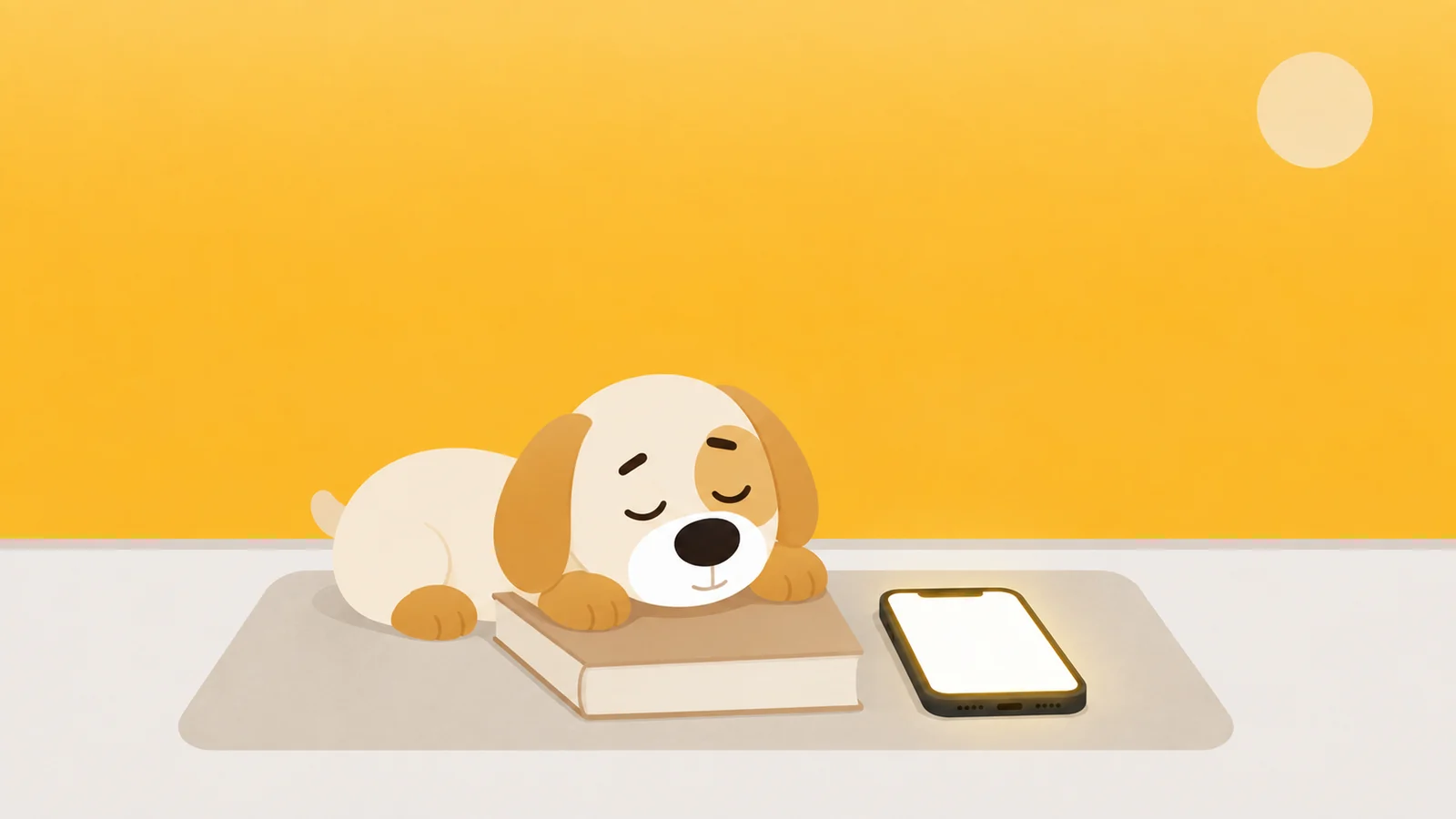
The book is nine inches from your hand and you are holding the phone.
You are not going to read tonight, and you knew that at about ten past ten, when you did the thing you always do, which is decide to read in a minute. The question underneath it is why you cannot read instead of scrolling, when reading is the thing you actually want and scrolling is the thing you actively resent by breakfast.
Reading is the standard wish. Not the guitar, not the language app, not the novel you were going to write. A book, in bed, like a person. It is so common a wish that nobody finds it interesting any more, which is a shame, because it is the most useful fact on this page.
You chose it because it is the opposite of scrolling. Quiet where the feed is loud, long where the feed is short, yours where the feed is somebody else's. Every property you like about it is a property the feed does not have.
Which is exactly why it loses. The opposite of a thing that is easy to start is a thing that is hard to start, and eleven at night is a starting problem, not a wanting problem.
You did not choose reading at random, and that is exactly why it loses
Here is the useful part, and you can measure it tonight without buying anything.
Pick up the book you last read four nights ago. Time it from opening the cover to actually being inside it, not moving your eyes across words but inside, with the room gone. Then put it down, unlock the phone, and time it from thumb to the first thing that holds you.
The second number is about three seconds. It is three seconds cold, three seconds tired, three seconds at any hour of any day, and it does not vary.
The first number is somewhere between ninety seconds and four minutes. That is not the problem. The problem is that you do not know which, in advance. A tired person will not begin an errand of unknown length, and every night at eleven you correctly identify the book as an errand of unknown length.
The book's real opponent is the ninety seconds before it starts
That first number has a name worth having: the reload.
Before you can read, you have to put back everything you were carrying when you stopped. Who these people are. What the last scene was doing and why it mattered. The rhythm of the sentences, which is a real thing you tune into and genuinely lose. None of that feels like reading. It feels like admin, done at the hour when you have the least appetite for admin, in order to earn the right to do the thing you wanted.
The feed has no reload. It never knew you were gone and it does not require you to have been anywhere.
So the highest-value line on this page is also the shortest one. Stop reading in the middle of a sentence. Not at the chapter break, not at the tidy white space. Mid-paragraph, at a point where you already know what the next line is going to do. It is old advice given to writers about where to break off for the day, and it works just as well at the reading end, for the same reason: tomorrow you come back to a running engine instead of a cold one.
It costs nothing, it needs no setting, and it removes most of the ninety seconds.
Four nights of not reading is not four failures. It is one failure, repeated, and it happens before the book is open.
Score the fight on the six things that actually decide it
Not on which one is better for you. You already know which one is better for you, and knowing it has never once helped at eleven. Score them on the six properties a tired person is unconsciously checking in the second before they reach.
| What decides it | The feed | The book |
|---|---|---|
| Time to the first good bit | About three seconds, cold, every time. | Ninety seconds to four minutes, and unknowable in advance. |
| Reload after four days away | None. It never noticed. | Names, place, last scene, and the rhythm of the prose. |
| Smallest satisfying piece | A few seconds. You can have exactly one. | A page, call it a minute. Half a page is nothing at all. |
| What being bored costs | Nothing. The next one is free and you did not pick this one. | Your choice, your money, your plan. The boredom has your name on it. |
| Who decides what happens next | It does, forever, without asking. | You do, at the bottom of every single page. |
| What you have at eight tomorrow | Nothing you could describe out loud. | Something you could describe out loud. |
Five to one.
Five rounds to one, and you have spent two years calling that score a character flaw.
Wanting to read and scrolling instead are not a contradiction
Look at where the book's one win sits. It is the last row, and it is the only row that settles after the decision has already been made.
Every round the phone wins pays out before you choose. The one round the book wins pays out at eight tomorrow morning.
Eleven at night is precisely the hour at which eight tomorrow morning does not exist. Not as an abstraction you have failed to appreciate. As a thing you can genuinely no longer see, the way you cannot see a colour in the dark. So the wanting and the scrolling are not in conflict at all. The wanting belongs to the version of you who can see tomorrow. The scrolling belongs to the one holding the phone, and they are not both in the room.
This is written for eleven, when you are still awake and still notionally deciding things. If your evening ends at a sensible time and then you surface at one in the morning already three swipes in, that is a different night with a different fix, and nothing on this page will touch it.
The strongest argument against all this is the one about the beach
It goes like this, and it is a good argument.
Last summer you read four hundred pages in three days. Same brain, same phone in the same pocket, same paper object with the same reload cost. Nothing in the table changed. So the properties cannot be what decides it, and the honest name for what changed is that you wanted it, you had the time, and you had picked a book that gripped.
Two things in that are true, and one of them is bigger than anything else here.
The first is that grip beats every arrangement on this page, including the ones below. A book you cannot put down does not need help from a setting. If your eleven o'clock book is one you are reading because you feel you should be the kind of person who has read it, the fight was rigged before it started, and no amount of arranging fixes a book you do not want.
The second is that people do read at eleven. Some of them read every night, and they are not a different species.
But the beach is not the counterexample it looks like. On the beach the phone was hot, the signal was poor, and there were four unclaimed hours in a row with nothing scheduled against them. The book did not beat the feed. The feed was not in the fight. Reading won a walkover and you came home and gave the credit to your character, which then failed to show up on the first Tuesday in September.
The beach did not fix you. The beach confiscated your phone and then took the credit for it.
So the objection keeps its best point and loses the conclusion. Book choice is the biggest lever anybody has. It just is not evidence that arrangement does not matter. It is evidence that the two work together, and that the holiday quietly supplied the half you keep forgetting to pack.
Two books, and only one of them has to beat a phone
The eleven o'clock book is not the improving book
Keep two on the go and give each one a job. The improving book is the long one, the important one, the one off the list. It gets daylight, a chair and a coffee, and it is allowed to be slow, because at two in the afternoon nothing is bidding against it.
The eleven o'clock book has one job: be more interesting than a phone while you are tired and slightly stupid. That is a low bar, and it is a real one. Genre is fine. A reread is fine. A book you loved at nineteen is more than fine, because the reload cost on a book you already know is close to zero.
Running two at once feels like cheating on the first one. It is the only version where either of them gets finished.
One more thing the table hands you. The smallest satisfying piece of a book is roughly a page, and a mass market paperback page runs somewhere near 250 to 300 words, which at ordinary speed is about a minute. So a book asks for a clean minute as its minimum unit, and at eleven you do not have clean minutes. You have ragged forty-second ones with a notification in the middle.
Which is an argument for the paper copy over the app, if you have the choice. Not for any reason involving light or wavelengths. Because a paper book is the only object in the bed that cannot show you something else.
Whichever one is within reach when you sit down is the one that wins
At eleven nobody goes and gets anything. You pick up whatever is already touching your hand. So the fight is not decided at eleven, it is decided in daylight, by whoever last put things down.
The book goes on the pillow, not on the nightstand. On the pillow it is in the way, and being in the way is the whole mechanism. The phone goes wherever standing up is required, which is a piece of advice with a well-known failure mode and its own honest account of it.
If you do read on the phone, there is one detail that costs a night the first time you meet it. A rule that shuts your phone down at bedtime shuts your reading app too, because the phone cannot tell a novel from a feed. Put the reading app on Settings › Screen Time › Always Allowed, then actually check it before the night you need it. The person who discovers at 11:20 that Books is behind the same door as Instagram does not go and find a paperback. They open Instagram.
And if the evening is going wrong earlier than eleven, the twenty minutes that decide it start at about half past ten, and there is a timed version of them with the exact taps.
You cannot win a fight you should not be holding
Read the six rows again and notice which side of the table you can actually reach.
Every lever above is a lever on the book. Cut the reload. Pick a book with grip. Put it on the pillow. All of that is real, all of it is free, and all of it is worth twenty minutes of a Sunday. Not one of them touches the other column, because the other column is not a set of habits. It is a product. Three seconds to reward is the product. No reload is the product. The next move being made for you, forever, without being asked, is the entire product, and there are people employed full time to shave another tenth of a second off the first of those numbers by Christmas.
So the honest version of the advice is not read more. It is: stop staging the fight. Take one of the two objects out of the room between two times you pick in advance, and the other one wins by walkover, exactly the way it did in August.
Screen Time will do that, it is free, and it is already on your phone. Go and set downtime if you have not. Its one weakness is the one every honest page about it admits: the door it puts up is a grey card with your own four digits behind it, and at eleven at night you know the digits, nobody watches you type them, and the fifth night is exactly as easy as the first.
Which is where we say what we make. Scrappy is a small dog who stands in front of the apps you name. He knows three rules and no fourth: quiet hours, a daily limit, and an open limit. Quiet hours is the one this article is about, and it is the plainest of the three. The door is shut between two times you choose, and he is standing in it. He does not have your Screen Time passcode and does not want it.
Knock once and he is polite about it. Keep knocking and he goes surprised, then firm, then down to a single word, then theatrically wounded. Getting past him costs a treat, and treats come out of walking, roughly two thousand steps for one, and buy five honest minutes. You cannot buy a treat with money. We have never sold them and we never will, which matters more at this hour than at any other, because it means whatever is in the jar at eleven was put there by a version of you who was outside and upright.
Every guarded app also gets a resistance level, and this is the setting the table above argues for. Negotiable opens for a treat. Firm makes you sit for ten seconds first, which is long enough to notice you did not really want it. Absolute means he will not take the treat at all, no price and nothing to discuss. The app that keeps beating your book is an absolute, and you already know which one it is.
There is an optional removal lock, because the move that wins at eleven is deleting the app and putting it back at twenty past. Switching that one off takes a day, which is deliberately longer than an urge lasts. There is an emergency pass, one a month, and he does not scold you for it. No account, no sign-up and no server of ours. Your Screen Time numbers are drawn by a sandboxed Apple extension that cannot phone home.
He does not care whether you read. That is not his job and he would be terrible at it. His job is that the other one is shut. What you do with the quiet is entirely your business, and if some of those evenings end up being a walk rather than a book, that is the one thing that beats a feed at close range anyway.
What he'd do
- Stop reading in the middle of a sentence. Not at the chapter break. Leave it mid-paragraph, at a line whose ending you already know, and tomorrow you walk back into a running engine instead of ninety seconds of admin.
- Keep two books and give each one a job. The improving one gets daylight and a chair. The eleven o'clock one only has to be more interesting than a phone while you are tired, which is a much lower bar and a fairer fight.
- Decide in daylight which one is within reach. Book on the pillow, where it is in the way. Phone somewhere that requires standing up. At eleven nobody goes and fetches anything, so whoever put things down last has already picked the winner.
Or take the other one out of the room.
Free to start, one whole rule, every safety rail. Quiet hours is the one this article is about.
Get Scrappy on the App StoreChecked against
- Apple's iPhone User Guide, checked 26 August 2026, for Screen Time and the Always Allowed list. That path was read in Apple's own current documentation rather than walked on a handset for this piece, and it sits at Settings, Screen Time, Always Allowed on iOS 26.
- The three seconds and the ninety seconds are not lifted from anybody's study. They are what those two objects do on your own nightstand, which is why the article asks you to time them rather than take our word for it.
- Page length: a mass market paperback page runs near 250 to 300 words, and at ordinary adult reading speed that is roughly a minute. Arithmetic rather than research. Time your own copy if the number matters.
- Stopping mid-sentence is long-standing advice given to writers about where to break off for the day. Applied here to the reading end, where it has the same effect for the same reason.